"Most games I play lack a protagonist figure with a distinct race or gender," I said on Twitter, having already examined this recently. Someone who disagreed replied that I "must not play many games" and suggested I examine the covers of the top ten bestsellers on vgchartz.com for what SJWs call "POC."
You often hear that race is a social construct. One popular SJW construction of race divides people into two categories, white and POC. POCs are non-white, but some POCs are "white-passing" and appear white, but from just the visual art on these covers I can't be expected to classify characters racially by anything but their appearance... it's a tangled web.
There's no standardization of what video game cover art depicts either. A game could crowd dozens of characters onto the cover, or not have even one. A character on a cover could be the only playable character, or one out of many, or not playable at all. The same game is often released with different covers for various reasons, like new editions, different marketing in different territories, or even so that the boxes are more collectable.
Because of complications like this I'm not going to try to make a tally, I'll simply comment on each cover. These are from the vgchartz April 4th global top sellers list.
Bloodborne
Bloodborne has at least two cover designs, a street scene with a figure and a figure on a blank background with the street scene rendered within the figure's outline. The figure faces away from the viewer, with no skin or hair visible, wearing an obscuring coat. It is impossible to classify this person racially.
I've also seen a third cover which appears to be a tight closeup of a similar figure carrying a saw-toothed blade, wearing a heavy coat and tricorn hat. This too lacks racial signifiers.
It's my understanding that you can make your own character in this game.
From Software is a Japanese developer. The publisher is Sony, the well-known Japanese megacorp (word borrowed, justifiably, from Shadowrun).
Henceforth I will solve the issue of variant cover designs by only examining the one featured on vgchartz. For Bloodborne, this is the blank-background figure linked second above.
Battlefield: Hardline (two entries)
The cover features one lightly bearded man in sunglasses and body armor with police markings, a jumbled pile of bundles of paper bills, a closeup of a gun, some skyscrapers, and an armored vehicle with police markings near an airplane. The color of the man's face has been digitally altered to a low-saturation cyan, making it impossible to determine his race.
EA DICE is a Swedish developer. Their parent company, EA, is American. Judging by the SWAT emblems, the game is set in America, although I don't recognize the pictured buildings.
MLB 15: The Show
The cover appears to be an altered photograph of a baseball player from behind. Except for selected blue elements, the picture has been desaturated, making the player's race visually indeterminate, but the name on the back of his uniform is Puig and his number is 66. This makes him identifiable as Yasiel Puig Valdés of the Dodgers, a POC.
SCE San Diego Studio is an American developer, and the game covers the top American baseball league. Sales figures indicate that the game's popularity is almost exclusive to North America. The developer's parent company is (through subsidiaries) Sony (Japanese).
3rd Super Robot WarZ: Tengoku-Hen (two entries)
No humans are visible on the cover, and I don't even know if those robots contain humans, are remotely piloted by humans, or are autonomous. I know extremely little about this game, only that it's a long-running series combining many fictional properties.
Like most titles in the series, the game has only been released in Japan. It is not clear to me whether it was developed by Banpresto or Winkysoft, both Japanese studios (vgcharts just lists the developer as "unknown"). The publisher is Japanese entertainment company Bandai Namco.
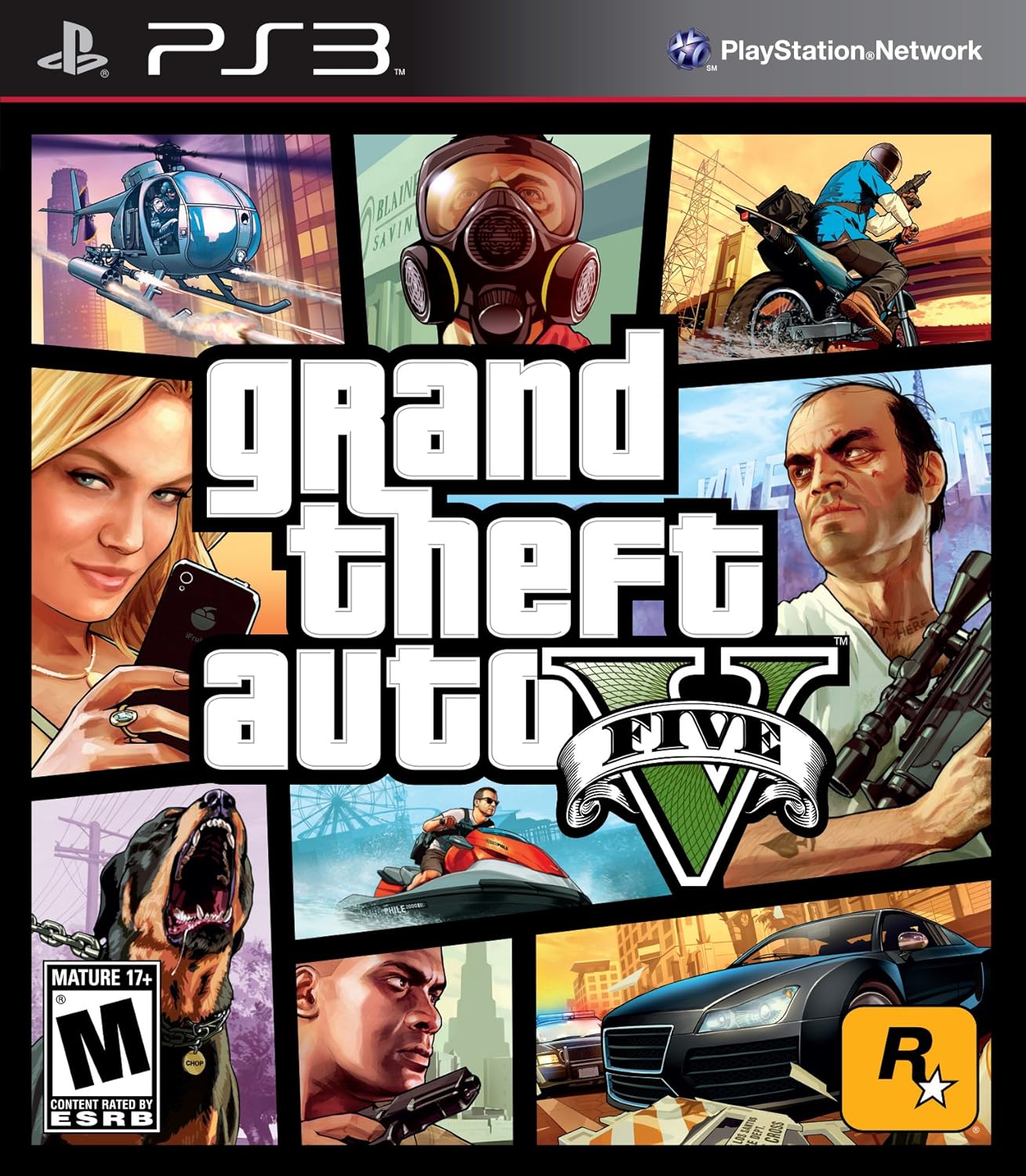
Grand Theft Auto V
The cover is split into separate panels, as is traditional for Grand Theft Auto. Clockwise from top left: possible white cop in a helicopter firing its rockets and guns, probable white man in a gas mask outside of a bank, possible white man on a motorcycle with a gun (the only clue is the color of his hands), probable white man with a scoped gun and a "cut here" neck tattoo, car, almost certainly white man on jet ski, probable black man with gun, baying dog named chop, white woman with smartphone.
Apart from the art style's treatment of lighting, and the smallness of details such as the face of the figure in the helicopter or the hands of the motorcyclist, I happen to know that GTA5 is set in a Los Angeles-like city, where I would expect a great many people to be — in SJW terms — white-passing POC. The tattooed man on the right, possibly white, could easily be POC. The POC man in the bottom center could be white with different assumptions about how he is lit.
The developer, Rockstar North, is Scottish. They are owned through Rockstar Games (American) by Take-Two Interactive (American). Take-Two is better known through its subsidiaries, Rockstar and 2K (American).
Mario Party 10
The cover has six visible characters, three of which are nonhuman (Bowser, Yoshi, and a green blob I don't recognize), and three of which are white (Peach, Mario, and Luigi). Peach has blonde hair and exceptionally fair skin. Mario and Luigi have fair skin. All three have blue eyes.
Nintendo is Japanese, and Mario and Luigi are canonically Italian, as if I needed to tell anyone this. I am not sure about the supposed racial history of the Mushroom Kingdom and its royal family.
Xenoblade Chronicles
The cover has no visible human figures. A red sword of unusual design is thrust into a grassy field near part of a rough wooden fence and an unidentifiable object in poor condition. Above this is the title, and above that is a vaguely humanoid, heavily armored construct with glowing red lights in the area you'd expect to find eyes.
Monolith Soft is a Japanese developer, and the game appears exclusively on Nintendo platforms.
The Sims 4
The cover shows eight people. Top row, left to right: white, white, white. Middle row: POC, unsure. Bottom row: white, white, unsure.
The last time I played a Sims game, you could make custom characters and even populate an entire neighborhood with them.
Developed by Maxis/The Sims Studio (American), owned by EA (American).
Conclusions
Five out of eight covers do not have any racially identifiable figures. (Two out of eight do not have human figures at all.) Of the remaining three, only Mario Party 10 has no POCs. GTA5 is very difficult to assess, but I believe the cover has at least one POC. The Sims 4 has between one and three POCs, and I presume that in the actual game it is possible to have POC characters.
The Twitter SJW who suggested this inquiry told me, "Look beyond the games you play. Learn something." The intention, or so I suppose, was that I would look at the box art of top sellers on vgchartz and be converted to the SJW position that there must be more POCs and less whites in video games than there are now. Instead, I didn't see anything to contradict my own position that if you like games with POCs (and judging by similar questions about gender, most people probably don't have a strong enough preference to change the games they play) you can play them right now, with no alteration of the hundred-billion-dollar video game industry necessary.

Tuesday, June 9, 2015




Saturday, May 30, 2015
Protagonist gender matters to few
Rosalind Wiseman and Ashly Burch were able to distribute a survey on gaming through school systems. One of the questions they asked was "Does protag[onist] gender affect your likelihood of playing [a game]?" They got over 1,400 responses, and on this question the answers leaned very strongly no (20/78 for boys, 28/70 for girls).
I wondered how people involved in Gamergate compared to this sample and resolved to poll them. I would ask the same question, offer the same answers, and get a somewhat directly comparable result. (Although bear in mind that my effort relied on volunteer responses, whereas it sounds like entire classes and grade levels at participating schools were required to answer the Wiseman/Burch questions.)
A recent Gamergate poll conducted from a controversial Twitter account got 1,807 responses (as of this writing). I thought I might be able to get a number around 1,400 with a single yes/no question, but I hadn't reckoned on poll fatigue in Gamergate, particularly in the immediate aftermath of a ten-question poll by Oliver Campbell. Many replies in a thread I made on 8chan about the poll complained about polls and data mining. As I write this, my question has only 336 replies. This is less than I'd hoped for, but still enough to talk about.
Responses to my question are 23 votes for yes to 313 votes for no, a 7/93 split. Wiseman/Burch already saw a strong lack of decisive gender preference in game selection; here it's absolutely overwhelming.
If I had to guess, I would say that people in Gamergate are likely to be making very informed decisions about which games to play, and putting genre, subject matter, word of mouth/user reviews, developer track record, and how a game looks in demos or Let's Plays over gender of the protagonist. Games don't even consistently have protagonists. Demonstrating this, here's a rundown of my installed games by protagonist gender:
35 games, 7 male protagonists, 3 female protagonists (4 if you count RFG: Demons of the Badlands or consider Lightning the protagonist of FF13), the rest indeterminate. In none of these cases did I select a game to buy or play based on the gender of its protagonist, but I did generally choose female protagonists when given the choice.
I want to share some quotes from replies to my poll thread on the Gamergate subreddit, KotakuInAction.
I wondered how people involved in Gamergate compared to this sample and resolved to poll them. I would ask the same question, offer the same answers, and get a somewhat directly comparable result. (Although bear in mind that my effort relied on volunteer responses, whereas it sounds like entire classes and grade levels at participating schools were required to answer the Wiseman/Burch questions.)
A recent Gamergate poll conducted from a controversial Twitter account got 1,807 responses (as of this writing). I thought I might be able to get a number around 1,400 with a single yes/no question, but I hadn't reckoned on poll fatigue in Gamergate, particularly in the immediate aftermath of a ten-question poll by Oliver Campbell. Many replies in a thread I made on 8chan about the poll complained about polls and data mining. As I write this, my question has only 336 replies. This is less than I'd hoped for, but still enough to talk about.
Responses to my question are 23 votes for yes to 313 votes for no, a 7/93 split. Wiseman/Burch already saw a strong lack of decisive gender preference in game selection; here it's absolutely overwhelming.
If I had to guess, I would say that people in Gamergate are likely to be making very informed decisions about which games to play, and putting genre, subject matter, word of mouth/user reviews, developer track record, and how a game looks in demos or Let's Plays over gender of the protagonist. Games don't even consistently have protagonists. Demonstrating this, here's a rundown of my installed games by protagonist gender:
- Age of Wonders 3: either/both
- Atom Zombie Smasher: neither
- Aurora: neither (I think)
- Children of the Nile: neither
- Cloudbuilt: female
- Democracy 2: neither
- Desktop Dungeons: unclear
- Dishonored: male (expansions: also male)
- Dwarf Fortress: neither
- Final Fantasy 13: both
- Football Manager 13: either
- Hunie Pop: either
- Incursion: either
- Killer is Dead: male
- Long Live the Queen: not sure, haven't played yet
- March of the Eagles: male
- Minecraft: either
- Mirror's Edge: female
- Napoleon: Total War: male
- Orcs Must Die! 2: either
- Panzer General: neither
- Progress Quest: neither (this is what sets PQ apart from a modern MMO)
- Red Faction: Guerrilla: male (expansion: female)
- Sanctum 2: either
- Skyrim: either
- Smugglers 4: either
- Spintires: neither
- Star Control 2: male
- Sunrider: Mask of Arcadius: not sure, haven't played yet
- Transistor: female
- Unity of Command: neither
- Valkyria Chronicles: male
- Victoria 2: either/neither
- Wargame: Red Dragon: neither
- XCOM: neither
35 games, 7 male protagonists, 3 female protagonists (4 if you count RFG: Demons of the Badlands or consider Lightning the protagonist of FF13), the rest indeterminate. In none of these cases did I select a game to buy or play based on the gender of its protagonist, but I did generally choose female protagonists when given the choice.
I want to share some quotes from replies to my poll thread on the Gamergate subreddit, KotakuInAction.
UberAndrew: "I of course don't speak for them but I have had friends that really preferred playing as males only because they liked being immersed and pretending they were their characters, so it would have been weird playing as a female."
Lusketrollet: "I voted "yes" because I overwhelmingly play action games. Few things look more fucking ludicrous than having a woman running around in a warzone while easily killing multiple muscular men. [...] I'm surprised there are so many people here who consciously choose to play a female character over a male character."
Grimlock2014: "could you imagine playing GTA 4 as a woman? It would be ridiculous."
Glorious_PC_Gamer: "Usually I pick male if I feel like the avatar is supposed to represent me, but I'm not against creating a female, either. [...] No big deal."
SpawnPointGuard: "If it's a choice between male and female, I almost always pick male, but the question is asking if it would change our likelihood of playing a game entirely. That just seems ridiculous to not play a game because you don't get your gender preference."
Broken_Pixel: "I answered no, but i feel and obvious, so why object to all the protagonists being woman etc. Well i object to this because i think that the designer should design what he/she/they want. Not forced to do what someone else wants."
wwoodi: "If a female was forced in to make whiny cunts happy then yes it does [influence whether I play]." Lusketrollet: "Exactly."
Raraara: "I always play females in games where I can choose. But I ain't gonna go cry home to mommy cause I can't. Just something I don't think about."
StayingOccupied: "Don't even care if they're human if the story is good and gameplay is fun."
j0eg0d: "Gender has no basis for the games I play"
UberAndrew: "If it's fun I don't care what gender the main character is. If I'm given the option of choosing my characters gender I usually pick female, but again, the gender doesn't really matter to me."
Furikuri_flcl: "Never Playing FFVI, Parasite Eve, Silent Hill 3, Metroid, Resident Evil, Okami, The Longest Journey, Mirror's Edge, Drill Dozer, Beyond Good and Evil, or Castlevania:OoE because of such a dumb reason? I think not!"
SigmaTheDJ: "I couldn't care less and I find the people that do a little baffling. For instance, is there really someone out there who'd say something like "I would love to play Tomb Raider, but I'm not playing it unless I can play as a man!"? I can't relate to anything like that." Glorious_PC_Gamer: "Me either, but it's funny that there are people who complain about the opposite. "I would love to play Dude Raider (Uncharted) but I'm not playing it unless I can play as a woman!""
Starkmoon: "In MMOs I prefer to play female characters because they have prettier rear ends. In Mass Effect I play fem-shep because of the quality of the voice acting. In other games I don't care, and not having a female option would never put me off."
katallaxis: "I've long had a policy of playing as a female character when given the option, because most games where you're not given the option are male, but otherwise it's not something I care very much about."
caz-: "If there's a choice, I always play as a female character. If it's first person, it doesn't bother me as much when there's no choice, because most of the time it makes no difference. If it's third person, I'm disappointed when there's no choice. If the game is good enough, I'm okay with it (e.g., Wild Hunt), but it definitely influences my likelihood of buying a game if I'm already on the fence about it."
castillle: "I voted yes because i do not want to play male characters in rpg/adventure games till i get out of saudi. Ive been here for 2 years. I had to stop my hrt to come here because I can save and help my family out. I have been playing a guy every time I have to leave the house out of fear of lashing/jailing by religious police or worse from other people. 1 more year and i can gtfo."
Friday, May 22, 2015
Against Keogh
I am sorry to be writing this. All of my attempts to write about
games have been driven by the ambition to write about gameplay. I didn't
want to write about how a game is made or marketed or whether you
should buy it, only about playing it. Now I'm writing about writing
about games. It is a dumb, low-value topic, but I found something even worse that needed a response.
EDIT: Keogh's paper has been moved to this URL.
The Short Version
Brendan Keogh equates how gamers treat casuals and/or non-gamers in real life to how humans treat Hollow Children in Binary Domain. There's no particular reason to make this comparison, he just does. He also takes for granted a gamer/casual divide that's nowhere near as clear as he imagines — the same person can play Starcraft 2 as a hardcore and Mortal Kombat X as a casual, and different Starcraft 2 players will have different ideas of the threshold between hardcore and casual — and pictures a monolithic gamer attitude in place of the actual kaleidoscope of communities scattered across the web and beyond.
The Long Version
"Through the course of Binary Domain's action-packed narrative, it becomes increasingly unclear who is human, who is machine, and who is somewhere in between."
You see it in folklore, in satire, and over and over in science fiction. It's a basic human anxiety, and its presence in Binary Domain's story is comparable to its presence in a film's story, but Keogh is going to use it as "evidence" that gamers are exclusionary.
"our everyday experiences are so ubiquitously augmented by technologies — even the act of playing Binary Domain by coupling with a virtual character through a videogame controller challenges any clear distinction between human and machine."
This is no more remarkable a human/machine interface than Keogh "coupling with" a virtual cursor to type this sentence into a word processor running on a personal computer. As he says, consumer electronics are commonplace. Their presence doesn't convey a special message. Keogh concedes this, but is trying to have his cake and eat it too by going on to exploit the unearned mystique of cybernetics and the unjustified social stigma of gamers.
I have to digress on my view of cybernetics. "Cyborg" suggests a very specific image in the narrow sense: someone with a robot arm, or an implanted device that allows for direct connection of the brain to an electronic interface. To me this is not especially unprecedented — humans have been using tools as body parts for a long time, starting with the clothing that allowed them to migrate to colder climates. (Someone once put it to me this way: "We never evolved out of the tropics, we just took the tropics with us under our clothes.")
Anybody who's worn shoes has been physically augmented, and it makes little difference to me if the shoes are not implants or electronics. Find yourself without shoes in the middle of a parking lot full of broken glass, or without glasses when you're trying to read, and see how lacking you feel. A removable body part can still be a body part. (For an example closer to popular ideas about cybernetics, consider a removable, non-electronic prosthetic for a hand or a leg.) If only an electronic implant counts, there are already pacemakers. If you're not a cyborg until your abilities are raised beyond human limits, I think we're in that ballpark.
It hasn't helped that Donna Haraway used the word and the metaphor in an influential paper. I'm not a feminist or a scholar, but it seems to me that Haraway's key point was that people are going to use the cultural resources they find around them for their own ends, and with that I would agree (for example, Chartists re-using concepts from Christianity). This has nothing to do, however, with the Robocop idea of a cyborg as a partially robotic soldier, or with nonhumans appearing human.
That a game would borrow a widespread and successful thematic concept from prior media means nothing in particular. Either a game is primarily a game and only needs to plug in whatever story works with its gameplay, or a game is primarily a story and made the same way as other stories in other media. If Binary Domain was an action movie, would it suggest that moviegoers divide the real world into human and inhuman based on whether they watch movies? Amusingly, Keogh is using the contention that gamer media demonstrates gamer othering to other gamers themselves, and benefiting from the extent to which this already happens in the academic study of games.
"This paper uses Binary Domain's complex anxieties towards technology as a lens through which to trace the histories of these constitutive modes of identifying with videogames, and to demonstrate the influence they have on shaping videogame forms and audiences"
This "lens" shit would be more accurately described as blinders. There's never just one variable in the social sciences (and when there is, it's poverty). A lens is just an announcement that you have a conclusion ready to go and will be ignoring anything that doesn't fit it. Oh my goodness, someone looked through the X lens and saw X. What a feat of inquiry.
These "complex anxieties toward technology" don't belong specifically to Binary Domain, or Terminator, or Blade Runner, or even technology. As discussed above, a non-human passing for human is a very basic fictional concept, and you can just as easily find it in Dracula. But as the user of a lens, Keogh has decided that come hell or high water he will insist that plot details from Binary Domain have a deep and specific relevance to gamers as a whole. I could develop an equally valid and far-reaching conclusion about gamers through the Bubble Bobble lens (such as "gamers believe their humanity has been lost and they are now monsters, but can re-earn that lost humanity by helping each other" — this is actually better than Keogh's paper already, although still without foundation and absurdly reductive).
"Sega's Binary Domain"
More specifically, developed by Sega's internal Yakuza Team, famous for the Yakuza series. Be aware as Keogh describes the game that it was made by a well-established Japanese development team.
"What it means to be a 'human' is a notion constantly challenged by the pervasive presence of technology in our everyday lives. Pacemakers, prosthetic limbs, automobiles, GPS, internet connections"
No. This is not a challenge. A cyborg is augmented but still a human being. If you seriously think having a car or an internet connection puts your humanity in question, go revive the Khmer Rouge (although even they killed people with glasses not due to their augmentation, but because they were presumed to be intellectuals). If you are suggesting gamers think this... they don't. People wouldn't embrace electronic entertainment if they thought they were throwing their humanity away by doing so.
"To play a videogame is to both expand and constrain bodily ability through technological augmentations (controllers, motion sensors, touchscreens) and to both step into and become part of an integrated circuit of human and nonhuman actors (Giddings and Kennedy 2008)."
The same could be said for driving a car, but Keogh is not building a negative case against the character of drivers, only gamers. This also fits poorly with Keogh's ideas about gamers as "hackers" who prize freedom of movement, examined below.
"the dominant identities cultivated around the videogame form by marketing and enthusiast press discourses"
This makes it sound as though gamers are at the intellectual mercy of outside manipulators. If marketing and the "enthusiast press" were the last word, there would have been no Gamergate, no Mass Effect 3 complaints, no backlash against Skyrim mods on Steam going commercial, no widespread suspicion of DLC or anti-preorder sentiment (no, TotalBiscuit did not start it, although his participation is appreciated). In fact gamers are very sophisticated about how they interact with louder voices like press organs and PR campaigns, spreading messages they agree with and challenging ones they don't. It's not all one-way tastemaking as Keogh would have you believe.
Gamer identity has formed in spite of marketing and the so-called enthusiast press and is the fiercest critic of — and most substantive opposition to — both.
"empowerment, agency, and choice"
Games are an interactive medium. If there's nothing to do, or only one thing to do, or what you do doesn't matter, the game sucks. The interactivity is the point of the medium, and taking it away is like taking away the text of a novel or the sound of a song. 4:33 is a gimmick and a blank book has yet to be written. So of course games are going to be about giving the player things to do, making those things important to the game, and offering a choice among things to do and outcomes.
"strong space marines, efficient racing cars, god-like (and god-eyed) strategists. Such dominant understandings of how players engage with videogames see players less as integrated and participatory cyborgs and more as dominant hackers: using the technology to do what they want it to do, to make the choices they want to make, to beat the technology, to win."
This is a fine example of how for Keogh the cyborg metaphor is a smoke grenade that helpfully blurs distinctions so he can draw whatever conclusions he wants to draw. Somehow the concept of a cyborg is not masterful enough — despite being associated with surpassing human limitations — to be associated with visibly (and stereotypically) cybernetic cyborgs like Warhammer 40,000's Space Marines. Instead, Keogh invokes the hacker, conveniently forgetting that the hacker stereotype includes physical weakness, and he describes these categories as "masculinist". This ain't Saudi Arabia. Women can drive cars.
Keogh has been going on about the close interface connection between gamers and games, but now he reverses course to say that gamers don't integrate into gameworlds or participate in them. This is nonsense. "Immersion" and "viscerality" are highly prized among gamers (although the latter word has become overused). People want to inhabit gameworlds while playing, they identify with controllable characters while playing ("I missed the jump and died"), they develop reflexes and bodies of knowledge to assist them in playing. They interact. It's an interactive medium.
There are very clear roles for the "hacker" archetype around games, but they're not the gamer at large. The hacker is, in descending order of status, the dev, the modder, the troubleshooter, and the cheater. But in the ordinary course of play, you are not a hacker, although you may be playing in the role of one (in the same way you might play in the role of a racer, a barman, or a princess).
Gaming is not hacking. Hacking involves considering the game as code. Gaming involves considering the game as a representation. The loser in Pong does not think of pixels turning off at one set of coordinates and on at another, but of the ball getting past the paddle. The traitor in The Matrix boasts of ignoring code-as-code and seeing only the intended virtual result; later he abdicates the hacker role of trying to crash or subvert the Matrix in favor of living within it on its own terms.
Winning is not a motivation in itself. If it were, games wouldn't be challenging. There's a sweet spot where success is possible but not assured. This sweet spot moves depending on individual skill, genre familiarity, patience, and so on, and games often offer variable difficulties to accommodate that. Increasingly, games also offer varying degrees of completion, with achievements, alternate endings, optional collectibles, and so on.
Some examples from my own experience:
1. I started Binary Domain on normal or hard (don't remember), got to a difficult point, and decided to put it on hold for a while to play other games. I haven't gotten back to it yet. My main interest in the game was the chance to see the work of Yakuza Team (which is otherwise a console-only shop, and I only have a PC). I am not a particular fan of shooters.
2. I played through Dishonored many times on the hardest difficulty, experimenting with different playing styles. I had a great time making it through the game without killing anyone, and again using only a minimum of the player character's supernatural powers. These challenges were suggested by the game's Achievement system; normally Achievements are stupid, but Dishonored uses them constructively. I enjoy stealth games, freedom of movement through complex environments, and variety in playing style.
3. I have not yet finished Spintires, but I am gradually working my way through every map on the hard difficulty. I've never played a game quite like this before, and there's also the technical issue of patches repeatedly breaking previous saved games.
4. I played Dwarf Fortress back in 2012 and hope to find time to experiment with the new version soon. The Dwarf Fortress community celebrates the game's open-ended march to doom with the slogan "Losing is fun!" There is no victory state, only the further challenges of continued survival. There have been similar games, often more accessible — a good example is Tilted Mill's Children of the Nile — but Dwarf Fortress has a unique approach. Neither I nor anyone else will win at Dwarf Fortress; this story captures the mood and structure of the game well.
5. I play Football Manager off and on. This game is wildly popular and its audience is a unique cross-section of gamers and sports fans. You do not directly control the players on the field, and nothing you do can assure that your team will win a game, only make it more likely. There is no formal difficulty setting of the easy/medium/hard variety, but which team you're in charge of will determine the nature of the struggle you face and the resources you can use. There is no final victory here either; the game can continue forever, presenting you with new challenges each season.
In short, gamers are playing to play, not to win. Playing can involve winning but doesn't have to. Winning plays different roles for different people in different games, including total absence from entire games. If Keogh was right about a hacker approach to games, everyone would just cheat, and games without win conditions wouldn't be popular. Even the top slots of score attack leaderboards record the "winning" player's score at the time they lost.
"Yet, with the rise of DIY or 'zinester' games at one end of the game design spectrum (Anthropy 2012) and casual and mobile games at the other (Juul 2010)"
What on earth is measured along this spectrum? What quality is it that is exhibited by DIY games the most, mobile games the least (as if these are necessarily separate categories), and Keogh's idea of a "gamer" game (Call of Duty, no doubt) a medium amount?
For that matter, if my examples didn't make it clear, an individual game can be played with different levels of casualness. A casual player can stumble their way through a fighting game's story mode, while a dedicated player can get into the competitive scene where the challenge level is sky-high. Even the Call of Duty games that stand for the great gamer boogeyman the ivory tower wants to kill have casual-friendly single-player campaigns.
"the core 'gamer' identity that values autonomy and mastery"
Gamers gladly accept restrictions and challenges in games if they enjoy the result. They may even add restrictions of their own, like the Thief community's "ghosting," in which levels must be completed without leaving any lasting trace of the player's passage. Gaming is entertainment, not Keogh's ideas of a pursuit of supremacy or total freedom. Dancing on mailboxes doesn't help people dominate World of Warcraft. Contra Keogh, gamers do participate in games.
"Tomas forwards technicity to account for the 'different systems of identity composition' that emerges in 'cyborg-dominated culture'"
But Keogh said that gamers are hackers, not cyborgs. Now he's bounced back to cyborgs because words mean whatever he wants them to mean at that moment.
"Concerns of technicity intersect with concerns of gender, ethnicity, and class"
They don't have to. Everywhere I see technology breaking these barriers down, and only people like Keogh building them back up. To hear these snowflake fucks tell it, Tetris can tell if a white man is playing and dispense 4x1 blocks accordingly. These are the new segregationists, flying in the face of everyone else's freewheeling experiences, warning against "cultural appropriation" and classifying everyone and everything by race and gender.
The truth is that people on the internet are interacting all the time across barriers of gender, ethnicity, and class, even if they don't know it, even if they would choose not to. The truth is that a global market for entertainment is growing and nobody has to stay excluded. The truth is that you don't have to be a man to play Deus Ex, or a woman to play Orcs Must Die 2, or Chilean to play Abyss Odyssey. It does not and should not matter, but Brendan Keogh is trying with all his might to make it matter, and to blame us, the gamers, for it.
While I appreciate the value of a word for how someone integrates technology into their life, and the breadth of variations that might encompass, "technicity" is a trick coinage that smuggles the associations of "ethnicity" into discussions of technology use. Even if this is one valid consideration in investigating technology use, it shouldn't be baked right into the word where it can pass unexamined and never be absent. I can't think of a good alternative off the top of my head (techation?), but there must be one.
"Videogames, this paper's analysis will demonstrate, privilege the hegemonic power of the 'hacker' technicity that underlines the 'gamer' identity while marginalising those videogames and their players that value technological engagements beyond the strictly ludic ones of goal-based mastery and challenge."
"Analysis," my ass, more like wild and unfounded speculation in line with Keogh's personal prejudices against gamers. Nothing is quantified; qualitative material isn't even consistent.
The most generous reading of this passage is that people who can make videogames ("hackers") get to make videogames ("hegemony") because they can make videogames ("privilege"). Well no shit. Yes you need to have some level of what might be described as "hacker" skills to make a game. That level isn't always high, but it's not zero; even tools like Twine and RPG Maker can be difficult to learn from scratch. This is an ace use of social justice language to make the obvious sound like oppression ("axe-having privileges axe-havers over woodcutting"), but if people want to make games, of course they will have to learn how.
You don't need to make games to play them, though. Personally, I don't think I have what it takes to learn game development, but I still enjoy playing games — which, as I have established, is not a "hacker" activity. I am an example of a gamer who doesn't need or pursue significant "hacker" skills. Anybody reading this on a computer or smartphone can do the same if playing games interests them. It's a very open medium and it doesn't require any social capital to experiment with. You don't need to join a bowling team or get a corporate sponsor. There are enough good free games that if you have the hardware, you don't even need to make further purchases, although depending on your tastes you may want to.
"The past five years has seen the emergence of a variety of videogames that conflict with traditional modes of understanding the videogame form"
Or rather, in the past five years a group of people wanting to steal credit for the idea of subversive experiments about games has formed. But there is precedent.
"This squadmate, ironically, suggests that the assemblage of flesh and machine that allows the character to perform so admirably (playable character, virtual camera, and a corporeal player entangled with videogame hardware) might be a cyborg."
Surely torpedoing Keogh's notion that gamers are hackers and not cyborgs because they are good at games. Or no, actually Keogh does not address how this contradicts that. Like I said, the qualitative isn't consistent. "Cyborg" can be applied to one set of things in one place and another in another.
"Binary Domain aligns itself with a long lineage of science fiction works in a variety of genres."
Finally Keogh acknowledges that Binary Domain is using familiar ideas and not something unique to games, but he doesn't get to the point of comparing Binary Domain's use of these plot elements and what he's using that to say about gamers with — for example — Blade Runner's plot and what he's not using that to say about film audiences. Gamers are singled out for vilification over a common thread that runs through games and non-games alike.
"how videogames, from the start, became naturalised as masculinist"
The earliest games were part of a very different environment, particularly in terms of who had access to hardware that could run games. That age is over. I know who's interpreting games as male now, and it's Keogh. If you are not a man, and you want to try playing a game, go ahead. This will not cause you to become a man. I'm not a gender essentialist and neither are games. Nobody is standing in your way on your gender's account, much as Keogh would like that.
"The focus on player agency that potentially prevents videogames being evaluated as texts"
Keogh invokes this in a list of supposed hacker-isms of gaming, but it's more interesting as a stumbling block for someone like Keogh who wants to evaluate games as texts. It's true that many games have stories, and in some games story seems to be primary, but as someone curtly described it on a forum once, "gameplay is what games a game a game." The important stories about games, the game-specific kind of stories, are the ones that are created during play. A game can include a conventional story in the same way a game's art assets can include a painting and its soundtrack can include a song, but it is the game itself, what is played, what the player can do, that is the game.
This attitude is not unique to (video) games; it's also a popular issue in pen-and-paper role-playing games, where players complain about lack of choice ("railroading") if they encounter it, and the wide-open nature of the medium's ability to respond to player involvement is seen as a great strength.
"the celebratory tone often invoked when discussing corporate technological advances"
Again, not unique to games at all. We live in a capitalist society and corporations are how much of our resource use is organized. It is only natural that the things around us should be created by capitalist structures, even if we don't like capitalism. Similarly, the dissident in the USSR might duplicate forbidden literature on a state-owned mimeograph machine made in a state-owned factory, and travel by state-operated bus to distribute it, but that isn't the dissident's endorsement of the system being protested, merely his presence in it. People use the cultural tools available to them for their own ends. Gamers are going to be interested in games whether they're released by Ubisoft or the Politburo Subsidiary Council for Virtual Jumping and Stabbing.
"user-generated content such as mods as somehow more liberating than conventional videogame play"
I don't think anyone would argue that this is uniformly true, or that the specific advantage of mods is that they are "liberating." (After all, isn't the ultimate "liberation" to simply stop playing?) Mods can be great, though, and part of that is that they don't have to answer to corporate masters. A big expensive game has a rigidly timetabled development cycle (that falls out of its timetable repeatedly before it's done), and after a certain point a game is probably not going to get any more updates, but modders can toil for years after release on an ever more polished and rich mod like Silent Hunter 3's Grey Wolves. A major company may have its hands tied by quirks of the market, like the prudery that left clothes on people in Skyrim even after their last articles of clothing were removed, but modders swept in and made things like Schlongs of Skyrim, a surprisingly detailed male nudity package. It's funny that in one set of commas Keogh associates corporate development with his "hacker" villain, and in the next he puts non-corporate development right alongside it.
"This is often explicitly gendered, too, such as Aarseth's (2004) comment that what Lara Croft's body in Tomb Raider looks like matters far less than what he can do with it, privileging the agency and actions of the player in a computational system over the gendered representational strategies of the videogame."
Aarseth says Lara Croft's gendering isn't enforced on the player. Keogh takes this to mean games are more gendered, not less. Or is he assigning a male gender to player action and a female gender to game setting? Either way this is stupid. Tomb Raider was never intended to require a particular player gender, and it doesn't.
"Just as the hacker is concerned with mastering complicated systems and ultimately beating the form of the computer, so too is the gamer concerned with mastering complicated systems of mechanics and ultimately beating the form of the videogame."
I could just as easily say that the cyborg is concerned with self-augmenting, becoming more effective, and adapting to more challenging situations.
"Writing in 2002 to defend the oft-dismissed videogame cut-scene"
Not that anyone should. Cutscenes are ungame smuggled into games. Gamers will accept some restriction as part of a game system, but balk at the total restriction cutscenes impose. Want a cutscene? See a movie. Stopping a game to show the player a cutscene is like stopping a movie to show the audience a sculpture. (Art students, please do not steal this idea and pretend it's good.)
"Klevjer explicitly claims ludology to be 'partly rooted in the dark arcade of the late 70's and early 80's, partly rooted in hacker culture'(193). That the study of videogames in many institutions still finds an uneasy home between humanities and computer engineering departments points towards the everydayness of these tensions."
In academia, maybe, where people hate games and gamers and constantly try to tar them with whatever negative label they can find or invent. In the industry the art and the craft of games* seem to be working pretty well together, and gamers experience them combined.
* I'm not entirely happy with this phrase, but you know what I mean and it's terse. Don't mine it too deeply for implications about what is an art and what is a craft; they aren't intended.
Keogh could stand to explain this supposed tension between arcade culture and hacker culture. Which group is it that supports cutscenes? I didn't put my quarter down to watch someone else's story, but Keogh's win-at-all-costs hackers wouldn't either. You can't win a cutscene. I guess QTEs have been trying to change that, but the trouble with QTEs gets back to agency, choice, and consequences — if there's only one option, it's not much of a game. A good game waits in suspense for the player, because it cannot predict what happens after the player's involvement, because the player's involvement makes a difference.
"As a consequence of its historical construction as masculine and its alignment with the hacker technicity that favours technological competency, mechanistic virtuosity, and systems literacy, discourses around videogames (both scholarly and popular) have produced what Dovey and Kennedy note is "an 'ideal' player subject that is naturalized as 'white', 'male' and 'heterosexual'""
None of this is stopping you if you happen not to be those three things or have those three aptitudes. My "technological competency" is low, and my "mechanistic virtuosity" and "systems literacy" vary a great deal from game to game and are typically unexceptional. In a multiplayer game, people aren't likely to be able to tell how straight or white or male I am, and in a single-player game (which I strongly prefer), there's nobody but me around to care.
Again: there is no social barrier. You do not have to make friends with any particular kind of people to start playing games. You can probably find a gaming subculture that you will fit into. If you want to play a game with friends, all you need is interested friends. You might meet new people in a game who don't like you, but that's just people being people. Games themselves don't even know how to socially exclude you.
"Dan is an archetypical white, heterosexual, macho American male"
Remember, this is the work of a Japanese developer. The game takes place in a half-ruined, dystopian, post-apocalyptic Japan, and the main characters are an international military squad — foreigners. Japan's history includes an American military occupation, so a foreign soldier character being American makes sense. By analogy, an American-developed Binary Domain could have taken place in a half-ruined, dystopian, post-apocalyptic United States, with the international special forces squad led by someone English. Playing as an American character isn't stopping Japanese audiences from enjoying Binary Domain any more than playing as a Japanese character is stopping American audiences from enjoying the Yakuza games.
(What really annoyed me about being stuck playing as Dan is that his primary weapon, an assault rifle, is general-purpose and rather generic. I had initially assumed you could switch between characters in the squad, and I wanted to try out their greater variety of weapons, but was disappointed to find that you cannot do this. My expectations may have been influenced by killer7, another Japanese game with a playable white man named Dan — in that game, there are several playable characters.)
"Rust Crew squadmate Faye Lee is a stereotypical, quiet, and slim"
Why, oh why, didn't they send the fat special forces team?
"not that Faye is a robot (a reveal that both Dan and the player come to expect)"
Shit, I was sure Dan would be a robot. At least Cain is probably a robot.
The way Keogh frames this, you'd think the moral of the story is that robots can't be tolerated and Faye gets killed right away, but from what I hear the player character takes Faye's side and protects her from anti-robot violence. It's also worth noting that one of the squad members in the game is openly a robot. My understanding is that while the New Geneva Convention and the Rust Crew's mission are pretty robot-negative, the real antagonist is whatever malign power controls the network of renegade robots and can activate the Hollow Children as sleeper agents. They play the death of the Hollow Child in the underground market as tragedy, or at least that's how I interpreted it. Just because there are characters in a story advocating the destruction of all robots doesn't mean that's the story's overall message.
"The hybrid people suggest, further, that despite being constituted solely by organic material, you may also be, simultaneously, a product of flesh and machine — an everyday cyborg."
I'll go a step beyond that — mechanized agriculture makes global population on the current scale possible, so we're all in a sense cyborg-born.
"Where the hacker strives for autonomy and dominance over the machine, the cyborg embraces the fact it is always already in part shaped and mediated by the machines it integrates with."
So in the hacker mode people might mod, cheat, code, configure, optimize, etc., but it's in the cyborg mode that people work with what's there, entering the deliberately unfinished experience of a game, accepting its restrictions and learning its rules, and becoming the element that completes it.
"takes as inherent those values in videogame marketing and design that are simply a dominant norm"
Once again gamer culture is described as top-down and bottom-up elements are ignored. No medium has the kind of feedback that games do.
"Dear Esther and Gone Home are exemplary of nascent modes of videogame design that do not offer the pleasure of mastery and control"
No, Dear Esther and Gone Home are examples of people trying to shoehorn their art projects into the game label just because they run on computers. Being in the Unreal Engine doesn't automatically make something a game (I believe Dear Esther was Source and Gone Home was Unity, but the point stands).
This gets into a debate people have about terminology, and this is not the only place I've seen it. In the pen-and-paper RPG world, from time to time there are arguments over whether something like Fiasco is an RPG. The subtext always seems to be that either it's good and an RPG, or it's bad and not an RPG. Advocates are really married to pushing it into that existing category, but I always wonder, what if it's good (Fiasco is good, by the way, if you enjoy making up stories with your friends), but we should find a new word for what it is?
I may or may not start a Twine project in the future; I've resisted calling it a game because it's not really what I would expect of a game. Instead, I describe it as an "adventure," after the Choose Your Own Adventure books that resemble the talk-tree structure of Twine. Similarly, I often see people adhere to a (mostly tacit) distinction between visual novels and games, and an explicit one between kinetic novels (with no choices at all) and visual novels (with at least some choices). Calling it not a game doesn't mean that it is necessarily bad, although as my first attempt it probably will be. But it is okay for something not to be a game. I'm reading China Mieville's The Scar right now, and if I had to evaluate it as a game, it would be absurd — no interactivity beyond turning the pages. But if I am free to consider it as what it is, which is not a game, it's a great novel and I will be pushing it on people later.
I haven't had positive experiences with what we might call "disputed games" yet, but that doesn't mean they're necessarily bad. This does not make them games, though. Uncharitably, I would say people want to hitch their wagons to a star, but the star does not shine for wagons. They want to tear the star down from the sky and harness it to their wagons, but the star shines on regardless. They tell us not to look at that star, but we'll still take our bearings by it. These people need to build their own star where they are and let it be that star which pulls those wagons.
Every new word is dumb to start with, and only takes on the characteristics of what it describes in retrospect. I've listened to hundreds of podcast episodes and never owned an ipod. So this is going to sound stupid and insulting and like I am trying to cheat disputed games out of their precious, value-conferring gameness, but let me suggest "lectro," for "electronic exhibit." This is a big potential category and a lot of it already exists. Any computer-incorporating museum and gallery displays qualify. You don't need any particular level of freedom or interactivity, and certainly not of challenge. The Path has been called a shitty game, but if you want to call it a shitty lectro, you'll have to consider it on the merits it's actually trying to have, not the things that set it apart from being a game. If you'd never seen a cat before, and your dog gave birth to a cat, you'd see catness as a horrifying birth defect. Approach things in their own categories rather than trying to make a square peg fit in a round hole.
I've got pretty high praise for a couple of lectros. Stellarium displays the sky at any given time and place, calculating the movements of the stars. Only useful in a narrow range of situations, certainly not a game, but it's really cool and worth messing around with. Similarly, Universe Sandbox simulates the motion of celestial bodies, and you can edit things freely, seeing what might happen if the moon and Jupiter switched places. Some people have already thought about gravity and orbits this way; my own understanding was limited and this added some color to it. As games these things are strangely crippled and lacking. As lectros they are whole.
"Casual games, such as Candy Crush Saga (King 2012) or Kim Kardashian: Hollywood"
I think this video is a strong case against the latter.
I generally avoid games which have microtransactions for a reason that will doubtless be called "masculinist" on some pretext or other: I don't like it when gameplay is tangled directly in real-world purchasing decisions. It takes me right out of enjoying a game to consider whether I want to use my own actual money to make a purchase, and these games are deliberately designed to bring the player to that crossroads early and often. People complaining about AAA games often target their consumerism, but in a F2P game you are still performing your actual, real-world, own-self consumerism inside the game. I see gaming as an escape and F2P makes things I'm trying to escape follow me.
"the freedom of movement taken for granted by players in many blockbuster games closely parallels the freedom of social movement possessed by the predominately white, straight, and male creators of those games."
I guess there was no freedom of movement in the works of Dani Bunten or Roberta Williams. This might be the most strained metaphor in this entire piece, and yes, I'm including gamer-as-noncyborg.
I'm going to lay down a suggestion here that I think ought to bind everyone: don't judge the creator's demographic categories, judge the work. No one should imagine that they are passing their race or gender on to the games they make, making "white games" or "male games." If I get a chance to play your game, I don't need to check your race before I decide if I like it.
"Mainichi (Brice 2012)"
Trust Keogh to plug this game. Brice, by the way, has a Patreon funding what she calls "Death to Video Games."
"This is perhaps most relevant of all to the renaissance of interactive fiction games seen through the development software Twine"
"Interactive fiction" is another good term for what I've been calling "adventures" and "visual novels." But it's no coincidence this genre had a long drought. As games developed, text adventures seemed more and more like mere puzzles, where the goal was to try every possible action in the hopes of stumbling on the one correct action the creator had predetermined, and the parser was more obstacle than interface. Point-and-click adventures suffered from some of the same problems, and also some new ones (like "pixel hunting").
"The domination and mastery of the hacker requires machine-like ability, while the cyborg exists, has always existed, in a direct relationship to the hacker from its inception."
Or the "hacker" is at least equally well described as a "cyborg" and Keogh has been saying nothing all along.
"the metaphor of cyborgism to explain the playable character's improbable and exceptional physical strength and dominance in the world."
Keogh struggles to present cyborgs as a universal game symbol here, when the real widespread phenomenon being observed is that player characters get powers. These powers are as likely to be explained by magic or preternatural skill as by technology, and even in the case of technology, they're as able to be equipment as implants. The rise of "RPG elements" has made a gradually unlocking tree of powers standard in games, allowing players to flexibly tailor the options available to them ingame. To his credit, Keogh acknowledges that his "cyborgs" can be magical, but this broadens the term to uselessness. It's supposed to simultaneously mean Robocop-style cyborg soldiers, nonhumans passing for human, avant-garde techno-feminism, anti-gamerness, anti-hackerness, and now any sort of "augmentation" from "powerful potions" to "an elven wraith."
"when Galloway claims that 'no gameplay is actually happening' at the moment the player stands on a virtual streetcorner to watch the sunset"
This is a fair point as far as it goes. Player inaction can be part of gameplay. This is often the case in stealth games, where the player may wait for an opportune gap in guard patrols before moving.
"It allows for understandings such as Golding's (2013) that see the player as navigating from within, rather than configuring from above, not unlike Haraway's feminist objectivity that insists we always see from somewhere (1988, 882)."
Keogh is way behind hardcore gamers here; there's a common feeling that it is somehow better to figure out a game yourself than go outside of it to consult a strategy guide, FAQ, external map, etc. That said, I think the validity of both approaches should be recognized, and it's about what the player personally wants at the moment. There have been many times I've relied on maps to find those last few collectibles, but also other times where I've continued experimenting on my own when stuck rather than see how other people did it.
"point towards how 'human' is a socially constructed concept with fluid but constantly policed borders."
A better comparison would be the boundary between song and spoken-word, or short story and novella, or movie and short. This is especially true as a common objection to what I earlier called "disputed games" is their length (often length vs. cost).
"no argument for either as 'wrong' or less accurate"
Fucking lies, this paper is completely anti-gamer. I don't exclude women, couldn't if I wanted to, enjoy games regardless of whether the people who created them or the characters within them match my own gender and ethnicity, and if I don't think a disputed game is a game, I'm perfectly willing to let it be an undisputed something else. I go from casual to hardcore myself from game to game, even session to session and ingame goal to ingame goal. We are all cyborgs, or none of us are.
I am a gamer. Stop smearing me.
Edited 06/13/15 to provide the new URL of Keogh's paper.
EDIT: Keogh's paper has been moved to this URL.
The Short Version
Brendan Keogh equates how gamers treat casuals and/or non-gamers in real life to how humans treat Hollow Children in Binary Domain. There's no particular reason to make this comparison, he just does. He also takes for granted a gamer/casual divide that's nowhere near as clear as he imagines — the same person can play Starcraft 2 as a hardcore and Mortal Kombat X as a casual, and different Starcraft 2 players will have different ideas of the threshold between hardcore and casual — and pictures a monolithic gamer attitude in place of the actual kaleidoscope of communities scattered across the web and beyond.
The Long Version
"Through the course of Binary Domain's action-packed narrative, it becomes increasingly unclear who is human, who is machine, and who is somewhere in between."
You see it in folklore, in satire, and over and over in science fiction. It's a basic human anxiety, and its presence in Binary Domain's story is comparable to its presence in a film's story, but Keogh is going to use it as "evidence" that gamers are exclusionary.
"our everyday experiences are so ubiquitously augmented by technologies — even the act of playing Binary Domain by coupling with a virtual character through a videogame controller challenges any clear distinction between human and machine."
This is no more remarkable a human/machine interface than Keogh "coupling with" a virtual cursor to type this sentence into a word processor running on a personal computer. As he says, consumer electronics are commonplace. Their presence doesn't convey a special message. Keogh concedes this, but is trying to have his cake and eat it too by going on to exploit the unearned mystique of cybernetics and the unjustified social stigma of gamers.
I have to digress on my view of cybernetics. "Cyborg" suggests a very specific image in the narrow sense: someone with a robot arm, or an implanted device that allows for direct connection of the brain to an electronic interface. To me this is not especially unprecedented — humans have been using tools as body parts for a long time, starting with the clothing that allowed them to migrate to colder climates. (Someone once put it to me this way: "We never evolved out of the tropics, we just took the tropics with us under our clothes.")
Anybody who's worn shoes has been physically augmented, and it makes little difference to me if the shoes are not implants or electronics. Find yourself without shoes in the middle of a parking lot full of broken glass, or without glasses when you're trying to read, and see how lacking you feel. A removable body part can still be a body part. (For an example closer to popular ideas about cybernetics, consider a removable, non-electronic prosthetic for a hand or a leg.) If only an electronic implant counts, there are already pacemakers. If you're not a cyborg until your abilities are raised beyond human limits, I think we're in that ballpark.
It hasn't helped that Donna Haraway used the word and the metaphor in an influential paper. I'm not a feminist or a scholar, but it seems to me that Haraway's key point was that people are going to use the cultural resources they find around them for their own ends, and with that I would agree (for example, Chartists re-using concepts from Christianity). This has nothing to do, however, with the Robocop idea of a cyborg as a partially robotic soldier, or with nonhumans appearing human.
That a game would borrow a widespread and successful thematic concept from prior media means nothing in particular. Either a game is primarily a game and only needs to plug in whatever story works with its gameplay, or a game is primarily a story and made the same way as other stories in other media. If Binary Domain was an action movie, would it suggest that moviegoers divide the real world into human and inhuman based on whether they watch movies? Amusingly, Keogh is using the contention that gamer media demonstrates gamer othering to other gamers themselves, and benefiting from the extent to which this already happens in the academic study of games.
"This paper uses Binary Domain's complex anxieties towards technology as a lens through which to trace the histories of these constitutive modes of identifying with videogames, and to demonstrate the influence they have on shaping videogame forms and audiences"
This "lens" shit would be more accurately described as blinders. There's never just one variable in the social sciences (and when there is, it's poverty). A lens is just an announcement that you have a conclusion ready to go and will be ignoring anything that doesn't fit it. Oh my goodness, someone looked through the X lens and saw X. What a feat of inquiry.
These "complex anxieties toward technology" don't belong specifically to Binary Domain, or Terminator, or Blade Runner, or even technology. As discussed above, a non-human passing for human is a very basic fictional concept, and you can just as easily find it in Dracula. But as the user of a lens, Keogh has decided that come hell or high water he will insist that plot details from Binary Domain have a deep and specific relevance to gamers as a whole. I could develop an equally valid and far-reaching conclusion about gamers through the Bubble Bobble lens (such as "gamers believe their humanity has been lost and they are now monsters, but can re-earn that lost humanity by helping each other" — this is actually better than Keogh's paper already, although still without foundation and absurdly reductive).
"Sega's Binary Domain"
More specifically, developed by Sega's internal Yakuza Team, famous for the Yakuza series. Be aware as Keogh describes the game that it was made by a well-established Japanese development team.
"What it means to be a 'human' is a notion constantly challenged by the pervasive presence of technology in our everyday lives. Pacemakers, prosthetic limbs, automobiles, GPS, internet connections"
No. This is not a challenge. A cyborg is augmented but still a human being. If you seriously think having a car or an internet connection puts your humanity in question, go revive the Khmer Rouge (although even they killed people with glasses not due to their augmentation, but because they were presumed to be intellectuals). If you are suggesting gamers think this... they don't. People wouldn't embrace electronic entertainment if they thought they were throwing their humanity away by doing so.
"To play a videogame is to both expand and constrain bodily ability through technological augmentations (controllers, motion sensors, touchscreens) and to both step into and become part of an integrated circuit of human and nonhuman actors (Giddings and Kennedy 2008)."
The same could be said for driving a car, but Keogh is not building a negative case against the character of drivers, only gamers. This also fits poorly with Keogh's ideas about gamers as "hackers" who prize freedom of movement, examined below.
"the dominant identities cultivated around the videogame form by marketing and enthusiast press discourses"
This makes it sound as though gamers are at the intellectual mercy of outside manipulators. If marketing and the "enthusiast press" were the last word, there would have been no Gamergate, no Mass Effect 3 complaints, no backlash against Skyrim mods on Steam going commercial, no widespread suspicion of DLC or anti-preorder sentiment (no, TotalBiscuit did not start it, although his participation is appreciated). In fact gamers are very sophisticated about how they interact with louder voices like press organs and PR campaigns, spreading messages they agree with and challenging ones they don't. It's not all one-way tastemaking as Keogh would have you believe.
Gamer identity has formed in spite of marketing and the so-called enthusiast press and is the fiercest critic of — and most substantive opposition to — both.
"empowerment, agency, and choice"
Games are an interactive medium. If there's nothing to do, or only one thing to do, or what you do doesn't matter, the game sucks. The interactivity is the point of the medium, and taking it away is like taking away the text of a novel or the sound of a song. 4:33 is a gimmick and a blank book has yet to be written. So of course games are going to be about giving the player things to do, making those things important to the game, and offering a choice among things to do and outcomes.
"strong space marines, efficient racing cars, god-like (and god-eyed) strategists. Such dominant understandings of how players engage with videogames see players less as integrated and participatory cyborgs and more as dominant hackers: using the technology to do what they want it to do, to make the choices they want to make, to beat the technology, to win."
This is a fine example of how for Keogh the cyborg metaphor is a smoke grenade that helpfully blurs distinctions so he can draw whatever conclusions he wants to draw. Somehow the concept of a cyborg is not masterful enough — despite being associated with surpassing human limitations — to be associated with visibly (and stereotypically) cybernetic cyborgs like Warhammer 40,000's Space Marines. Instead, Keogh invokes the hacker, conveniently forgetting that the hacker stereotype includes physical weakness, and he describes these categories as "masculinist". This ain't Saudi Arabia. Women can drive cars.
Keogh has been going on about the close interface connection between gamers and games, but now he reverses course to say that gamers don't integrate into gameworlds or participate in them. This is nonsense. "Immersion" and "viscerality" are highly prized among gamers (although the latter word has become overused). People want to inhabit gameworlds while playing, they identify with controllable characters while playing ("I missed the jump and died"), they develop reflexes and bodies of knowledge to assist them in playing. They interact. It's an interactive medium.
There are very clear roles for the "hacker" archetype around games, but they're not the gamer at large. The hacker is, in descending order of status, the dev, the modder, the troubleshooter, and the cheater. But in the ordinary course of play, you are not a hacker, although you may be playing in the role of one (in the same way you might play in the role of a racer, a barman, or a princess).
Gaming is not hacking. Hacking involves considering the game as code. Gaming involves considering the game as a representation. The loser in Pong does not think of pixels turning off at one set of coordinates and on at another, but of the ball getting past the paddle. The traitor in The Matrix boasts of ignoring code-as-code and seeing only the intended virtual result; later he abdicates the hacker role of trying to crash or subvert the Matrix in favor of living within it on its own terms.
Winning is not a motivation in itself. If it were, games wouldn't be challenging. There's a sweet spot where success is possible but not assured. This sweet spot moves depending on individual skill, genre familiarity, patience, and so on, and games often offer variable difficulties to accommodate that. Increasingly, games also offer varying degrees of completion, with achievements, alternate endings, optional collectibles, and so on.
Some examples from my own experience:
1. I started Binary Domain on normal or hard (don't remember), got to a difficult point, and decided to put it on hold for a while to play other games. I haven't gotten back to it yet. My main interest in the game was the chance to see the work of Yakuza Team (which is otherwise a console-only shop, and I only have a PC). I am not a particular fan of shooters.
2. I played through Dishonored many times on the hardest difficulty, experimenting with different playing styles. I had a great time making it through the game without killing anyone, and again using only a minimum of the player character's supernatural powers. These challenges were suggested by the game's Achievement system; normally Achievements are stupid, but Dishonored uses them constructively. I enjoy stealth games, freedom of movement through complex environments, and variety in playing style.
3. I have not yet finished Spintires, but I am gradually working my way through every map on the hard difficulty. I've never played a game quite like this before, and there's also the technical issue of patches repeatedly breaking previous saved games.
4. I played Dwarf Fortress back in 2012 and hope to find time to experiment with the new version soon. The Dwarf Fortress community celebrates the game's open-ended march to doom with the slogan "Losing is fun!" There is no victory state, only the further challenges of continued survival. There have been similar games, often more accessible — a good example is Tilted Mill's Children of the Nile — but Dwarf Fortress has a unique approach. Neither I nor anyone else will win at Dwarf Fortress; this story captures the mood and structure of the game well.
5. I play Football Manager off and on. This game is wildly popular and its audience is a unique cross-section of gamers and sports fans. You do not directly control the players on the field, and nothing you do can assure that your team will win a game, only make it more likely. There is no formal difficulty setting of the easy/medium/hard variety, but which team you're in charge of will determine the nature of the struggle you face and the resources you can use. There is no final victory here either; the game can continue forever, presenting you with new challenges each season.
In short, gamers are playing to play, not to win. Playing can involve winning but doesn't have to. Winning plays different roles for different people in different games, including total absence from entire games. If Keogh was right about a hacker approach to games, everyone would just cheat, and games without win conditions wouldn't be popular. Even the top slots of score attack leaderboards record the "winning" player's score at the time they lost.
"Yet, with the rise of DIY or 'zinester' games at one end of the game design spectrum (Anthropy 2012) and casual and mobile games at the other (Juul 2010)"
What on earth is measured along this spectrum? What quality is it that is exhibited by DIY games the most, mobile games the least (as if these are necessarily separate categories), and Keogh's idea of a "gamer" game (Call of Duty, no doubt) a medium amount?
For that matter, if my examples didn't make it clear, an individual game can be played with different levels of casualness. A casual player can stumble their way through a fighting game's story mode, while a dedicated player can get into the competitive scene where the challenge level is sky-high. Even the Call of Duty games that stand for the great gamer boogeyman the ivory tower wants to kill have casual-friendly single-player campaigns.
"the core 'gamer' identity that values autonomy and mastery"
Gamers gladly accept restrictions and challenges in games if they enjoy the result. They may even add restrictions of their own, like the Thief community's "ghosting," in which levels must be completed without leaving any lasting trace of the player's passage. Gaming is entertainment, not Keogh's ideas of a pursuit of supremacy or total freedom. Dancing on mailboxes doesn't help people dominate World of Warcraft. Contra Keogh, gamers do participate in games.
"Tomas forwards technicity to account for the 'different systems of identity composition' that emerges in 'cyborg-dominated culture'"
But Keogh said that gamers are hackers, not cyborgs. Now he's bounced back to cyborgs because words mean whatever he wants them to mean at that moment.
"Concerns of technicity intersect with concerns of gender, ethnicity, and class"
They don't have to. Everywhere I see technology breaking these barriers down, and only people like Keogh building them back up. To hear these snowflake fucks tell it, Tetris can tell if a white man is playing and dispense 4x1 blocks accordingly. These are the new segregationists, flying in the face of everyone else's freewheeling experiences, warning against "cultural appropriation" and classifying everyone and everything by race and gender.
The truth is that people on the internet are interacting all the time across barriers of gender, ethnicity, and class, even if they don't know it, even if they would choose not to. The truth is that a global market for entertainment is growing and nobody has to stay excluded. The truth is that you don't have to be a man to play Deus Ex, or a woman to play Orcs Must Die 2, or Chilean to play Abyss Odyssey. It does not and should not matter, but Brendan Keogh is trying with all his might to make it matter, and to blame us, the gamers, for it.
While I appreciate the value of a word for how someone integrates technology into their life, and the breadth of variations that might encompass, "technicity" is a trick coinage that smuggles the associations of "ethnicity" into discussions of technology use. Even if this is one valid consideration in investigating technology use, it shouldn't be baked right into the word where it can pass unexamined and never be absent. I can't think of a good alternative off the top of my head (techation?), but there must be one.
"Videogames, this paper's analysis will demonstrate, privilege the hegemonic power of the 'hacker' technicity that underlines the 'gamer' identity while marginalising those videogames and their players that value technological engagements beyond the strictly ludic ones of goal-based mastery and challenge."
"Analysis," my ass, more like wild and unfounded speculation in line with Keogh's personal prejudices against gamers. Nothing is quantified; qualitative material isn't even consistent.
The most generous reading of this passage is that people who can make videogames ("hackers") get to make videogames ("hegemony") because they can make videogames ("privilege"). Well no shit. Yes you need to have some level of what might be described as "hacker" skills to make a game. That level isn't always high, but it's not zero; even tools like Twine and RPG Maker can be difficult to learn from scratch. This is an ace use of social justice language to make the obvious sound like oppression ("axe-having privileges axe-havers over woodcutting"), but if people want to make games, of course they will have to learn how.
You don't need to make games to play them, though. Personally, I don't think I have what it takes to learn game development, but I still enjoy playing games — which, as I have established, is not a "hacker" activity. I am an example of a gamer who doesn't need or pursue significant "hacker" skills. Anybody reading this on a computer or smartphone can do the same if playing games interests them. It's a very open medium and it doesn't require any social capital to experiment with. You don't need to join a bowling team or get a corporate sponsor. There are enough good free games that if you have the hardware, you don't even need to make further purchases, although depending on your tastes you may want to.
"The past five years has seen the emergence of a variety of videogames that conflict with traditional modes of understanding the videogame form"
Or rather, in the past five years a group of people wanting to steal credit for the idea of subversive experiments about games has formed. But there is precedent.
"This squadmate, ironically, suggests that the assemblage of flesh and machine that allows the character to perform so admirably (playable character, virtual camera, and a corporeal player entangled with videogame hardware) might be a cyborg."
Surely torpedoing Keogh's notion that gamers are hackers and not cyborgs because they are good at games. Or no, actually Keogh does not address how this contradicts that. Like I said, the qualitative isn't consistent. "Cyborg" can be applied to one set of things in one place and another in another.
"Binary Domain aligns itself with a long lineage of science fiction works in a variety of genres."
Finally Keogh acknowledges that Binary Domain is using familiar ideas and not something unique to games, but he doesn't get to the point of comparing Binary Domain's use of these plot elements and what he's using that to say about gamers with — for example — Blade Runner's plot and what he's not using that to say about film audiences. Gamers are singled out for vilification over a common thread that runs through games and non-games alike.
"how videogames, from the start, became naturalised as masculinist"
The earliest games were part of a very different environment, particularly in terms of who had access to hardware that could run games. That age is over. I know who's interpreting games as male now, and it's Keogh. If you are not a man, and you want to try playing a game, go ahead. This will not cause you to become a man. I'm not a gender essentialist and neither are games. Nobody is standing in your way on your gender's account, much as Keogh would like that.
"The focus on player agency that potentially prevents videogames being evaluated as texts"
Keogh invokes this in a list of supposed hacker-isms of gaming, but it's more interesting as a stumbling block for someone like Keogh who wants to evaluate games as texts. It's true that many games have stories, and in some games story seems to be primary, but as someone curtly described it on a forum once, "gameplay is what games a game a game." The important stories about games, the game-specific kind of stories, are the ones that are created during play. A game can include a conventional story in the same way a game's art assets can include a painting and its soundtrack can include a song, but it is the game itself, what is played, what the player can do, that is the game.
This attitude is not unique to (video) games; it's also a popular issue in pen-and-paper role-playing games, where players complain about lack of choice ("railroading") if they encounter it, and the wide-open nature of the medium's ability to respond to player involvement is seen as a great strength.
"the celebratory tone often invoked when discussing corporate technological advances"
Again, not unique to games at all. We live in a capitalist society and corporations are how much of our resource use is organized. It is only natural that the things around us should be created by capitalist structures, even if we don't like capitalism. Similarly, the dissident in the USSR might duplicate forbidden literature on a state-owned mimeograph machine made in a state-owned factory, and travel by state-operated bus to distribute it, but that isn't the dissident's endorsement of the system being protested, merely his presence in it. People use the cultural tools available to them for their own ends. Gamers are going to be interested in games whether they're released by Ubisoft or the Politburo Subsidiary Council for Virtual Jumping and Stabbing.
"user-generated content such as mods as somehow more liberating than conventional videogame play"
I don't think anyone would argue that this is uniformly true, or that the specific advantage of mods is that they are "liberating." (After all, isn't the ultimate "liberation" to simply stop playing?) Mods can be great, though, and part of that is that they don't have to answer to corporate masters. A big expensive game has a rigidly timetabled development cycle (that falls out of its timetable repeatedly before it's done), and after a certain point a game is probably not going to get any more updates, but modders can toil for years after release on an ever more polished and rich mod like Silent Hunter 3's Grey Wolves. A major company may have its hands tied by quirks of the market, like the prudery that left clothes on people in Skyrim even after their last articles of clothing were removed, but modders swept in and made things like Schlongs of Skyrim, a surprisingly detailed male nudity package. It's funny that in one set of commas Keogh associates corporate development with his "hacker" villain, and in the next he puts non-corporate development right alongside it.
"This is often explicitly gendered, too, such as Aarseth's (2004) comment that what Lara Croft's body in Tomb Raider looks like matters far less than what he can do with it, privileging the agency and actions of the player in a computational system over the gendered representational strategies of the videogame."
Aarseth says Lara Croft's gendering isn't enforced on the player. Keogh takes this to mean games are more gendered, not less. Or is he assigning a male gender to player action and a female gender to game setting? Either way this is stupid. Tomb Raider was never intended to require a particular player gender, and it doesn't.
"Just as the hacker is concerned with mastering complicated systems and ultimately beating the form of the computer, so too is the gamer concerned with mastering complicated systems of mechanics and ultimately beating the form of the videogame."
I could just as easily say that the cyborg is concerned with self-augmenting, becoming more effective, and adapting to more challenging situations.
"Writing in 2002 to defend the oft-dismissed videogame cut-scene"
Not that anyone should. Cutscenes are ungame smuggled into games. Gamers will accept some restriction as part of a game system, but balk at the total restriction cutscenes impose. Want a cutscene? See a movie. Stopping a game to show the player a cutscene is like stopping a movie to show the audience a sculpture. (Art students, please do not steal this idea and pretend it's good.)
"Klevjer explicitly claims ludology to be 'partly rooted in the dark arcade of the late 70's and early 80's, partly rooted in hacker culture'(193). That the study of videogames in many institutions still finds an uneasy home between humanities and computer engineering departments points towards the everydayness of these tensions."
In academia, maybe, where people hate games and gamers and constantly try to tar them with whatever negative label they can find or invent. In the industry the art and the craft of games* seem to be working pretty well together, and gamers experience them combined.
* I'm not entirely happy with this phrase, but you know what I mean and it's terse. Don't mine it too deeply for implications about what is an art and what is a craft; they aren't intended.
Keogh could stand to explain this supposed tension between arcade culture and hacker culture. Which group is it that supports cutscenes? I didn't put my quarter down to watch someone else's story, but Keogh's win-at-all-costs hackers wouldn't either. You can't win a cutscene. I guess QTEs have been trying to change that, but the trouble with QTEs gets back to agency, choice, and consequences — if there's only one option, it's not much of a game. A good game waits in suspense for the player, because it cannot predict what happens after the player's involvement, because the player's involvement makes a difference.
"As a consequence of its historical construction as masculine and its alignment with the hacker technicity that favours technological competency, mechanistic virtuosity, and systems literacy, discourses around videogames (both scholarly and popular) have produced what Dovey and Kennedy note is "an 'ideal' player subject that is naturalized as 'white', 'male' and 'heterosexual'""
None of this is stopping you if you happen not to be those three things or have those three aptitudes. My "technological competency" is low, and my "mechanistic virtuosity" and "systems literacy" vary a great deal from game to game and are typically unexceptional. In a multiplayer game, people aren't likely to be able to tell how straight or white or male I am, and in a single-player game (which I strongly prefer), there's nobody but me around to care.
Again: there is no social barrier. You do not have to make friends with any particular kind of people to start playing games. You can probably find a gaming subculture that you will fit into. If you want to play a game with friends, all you need is interested friends. You might meet new people in a game who don't like you, but that's just people being people. Games themselves don't even know how to socially exclude you.
"Dan is an archetypical white, heterosexual, macho American male"
Remember, this is the work of a Japanese developer. The game takes place in a half-ruined, dystopian, post-apocalyptic Japan, and the main characters are an international military squad — foreigners. Japan's history includes an American military occupation, so a foreign soldier character being American makes sense. By analogy, an American-developed Binary Domain could have taken place in a half-ruined, dystopian, post-apocalyptic United States, with the international special forces squad led by someone English. Playing as an American character isn't stopping Japanese audiences from enjoying Binary Domain any more than playing as a Japanese character is stopping American audiences from enjoying the Yakuza games.
(What really annoyed me about being stuck playing as Dan is that his primary weapon, an assault rifle, is general-purpose and rather generic. I had initially assumed you could switch between characters in the squad, and I wanted to try out their greater variety of weapons, but was disappointed to find that you cannot do this. My expectations may have been influenced by killer7, another Japanese game with a playable white man named Dan — in that game, there are several playable characters.)
"Rust Crew squadmate Faye Lee is a stereotypical, quiet, and slim"
Why, oh why, didn't they send the fat special forces team?
"not that Faye is a robot (a reveal that both Dan and the player come to expect)"
Shit, I was sure Dan would be a robot. At least Cain is probably a robot.
The way Keogh frames this, you'd think the moral of the story is that robots can't be tolerated and Faye gets killed right away, but from what I hear the player character takes Faye's side and protects her from anti-robot violence. It's also worth noting that one of the squad members in the game is openly a robot. My understanding is that while the New Geneva Convention and the Rust Crew's mission are pretty robot-negative, the real antagonist is whatever malign power controls the network of renegade robots and can activate the Hollow Children as sleeper agents. They play the death of the Hollow Child in the underground market as tragedy, or at least that's how I interpreted it. Just because there are characters in a story advocating the destruction of all robots doesn't mean that's the story's overall message.
"The hybrid people suggest, further, that despite being constituted solely by organic material, you may also be, simultaneously, a product of flesh and machine — an everyday cyborg."
I'll go a step beyond that — mechanized agriculture makes global population on the current scale possible, so we're all in a sense cyborg-born.
"Where the hacker strives for autonomy and dominance over the machine, the cyborg embraces the fact it is always already in part shaped and mediated by the machines it integrates with."
So in the hacker mode people might mod, cheat, code, configure, optimize, etc., but it's in the cyborg mode that people work with what's there, entering the deliberately unfinished experience of a game, accepting its restrictions and learning its rules, and becoming the element that completes it.
"takes as inherent those values in videogame marketing and design that are simply a dominant norm"
Once again gamer culture is described as top-down and bottom-up elements are ignored. No medium has the kind of feedback that games do.
"Dear Esther and Gone Home are exemplary of nascent modes of videogame design that do not offer the pleasure of mastery and control"
No, Dear Esther and Gone Home are examples of people trying to shoehorn their art projects into the game label just because they run on computers. Being in the Unreal Engine doesn't automatically make something a game (I believe Dear Esther was Source and Gone Home was Unity, but the point stands).
This gets into a debate people have about terminology, and this is not the only place I've seen it. In the pen-and-paper RPG world, from time to time there are arguments over whether something like Fiasco is an RPG. The subtext always seems to be that either it's good and an RPG, or it's bad and not an RPG. Advocates are really married to pushing it into that existing category, but I always wonder, what if it's good (Fiasco is good, by the way, if you enjoy making up stories with your friends), but we should find a new word for what it is?
I may or may not start a Twine project in the future; I've resisted calling it a game because it's not really what I would expect of a game. Instead, I describe it as an "adventure," after the Choose Your Own Adventure books that resemble the talk-tree structure of Twine. Similarly, I often see people adhere to a (mostly tacit) distinction between visual novels and games, and an explicit one between kinetic novels (with no choices at all) and visual novels (with at least some choices). Calling it not a game doesn't mean that it is necessarily bad, although as my first attempt it probably will be. But it is okay for something not to be a game. I'm reading China Mieville's The Scar right now, and if I had to evaluate it as a game, it would be absurd — no interactivity beyond turning the pages. But if I am free to consider it as what it is, which is not a game, it's a great novel and I will be pushing it on people later.
I haven't had positive experiences with what we might call "disputed games" yet, but that doesn't mean they're necessarily bad. This does not make them games, though. Uncharitably, I would say people want to hitch their wagons to a star, but the star does not shine for wagons. They want to tear the star down from the sky and harness it to their wagons, but the star shines on regardless. They tell us not to look at that star, but we'll still take our bearings by it. These people need to build their own star where they are and let it be that star which pulls those wagons.
Every new word is dumb to start with, and only takes on the characteristics of what it describes in retrospect. I've listened to hundreds of podcast episodes and never owned an ipod. So this is going to sound stupid and insulting and like I am trying to cheat disputed games out of their precious, value-conferring gameness, but let me suggest "lectro," for "electronic exhibit." This is a big potential category and a lot of it already exists. Any computer-incorporating museum and gallery displays qualify. You don't need any particular level of freedom or interactivity, and certainly not of challenge. The Path has been called a shitty game, but if you want to call it a shitty lectro, you'll have to consider it on the merits it's actually trying to have, not the things that set it apart from being a game. If you'd never seen a cat before, and your dog gave birth to a cat, you'd see catness as a horrifying birth defect. Approach things in their own categories rather than trying to make a square peg fit in a round hole.
I've got pretty high praise for a couple of lectros. Stellarium displays the sky at any given time and place, calculating the movements of the stars. Only useful in a narrow range of situations, certainly not a game, but it's really cool and worth messing around with. Similarly, Universe Sandbox simulates the motion of celestial bodies, and you can edit things freely, seeing what might happen if the moon and Jupiter switched places. Some people have already thought about gravity and orbits this way; my own understanding was limited and this added some color to it. As games these things are strangely crippled and lacking. As lectros they are whole.
"Casual games, such as Candy Crush Saga (King 2012) or Kim Kardashian: Hollywood"
I think this video is a strong case against the latter.
I generally avoid games which have microtransactions for a reason that will doubtless be called "masculinist" on some pretext or other: I don't like it when gameplay is tangled directly in real-world purchasing decisions. It takes me right out of enjoying a game to consider whether I want to use my own actual money to make a purchase, and these games are deliberately designed to bring the player to that crossroads early and often. People complaining about AAA games often target their consumerism, but in a F2P game you are still performing your actual, real-world, own-self consumerism inside the game. I see gaming as an escape and F2P makes things I'm trying to escape follow me.
"the freedom of movement taken for granted by players in many blockbuster games closely parallels the freedom of social movement possessed by the predominately white, straight, and male creators of those games."
I guess there was no freedom of movement in the works of Dani Bunten or Roberta Williams. This might be the most strained metaphor in this entire piece, and yes, I'm including gamer-as-noncyborg.
I'm going to lay down a suggestion here that I think ought to bind everyone: don't judge the creator's demographic categories, judge the work. No one should imagine that they are passing their race or gender on to the games they make, making "white games" or "male games." If I get a chance to play your game, I don't need to check your race before I decide if I like it.
"Mainichi (Brice 2012)"
Trust Keogh to plug this game. Brice, by the way, has a Patreon funding what she calls "Death to Video Games."
"This is perhaps most relevant of all to the renaissance of interactive fiction games seen through the development software Twine"
"Interactive fiction" is another good term for what I've been calling "adventures" and "visual novels." But it's no coincidence this genre had a long drought. As games developed, text adventures seemed more and more like mere puzzles, where the goal was to try every possible action in the hopes of stumbling on the one correct action the creator had predetermined, and the parser was more obstacle than interface. Point-and-click adventures suffered from some of the same problems, and also some new ones (like "pixel hunting").
"The domination and mastery of the hacker requires machine-like ability, while the cyborg exists, has always existed, in a direct relationship to the hacker from its inception."
Or the "hacker" is at least equally well described as a "cyborg" and Keogh has been saying nothing all along.
"the metaphor of cyborgism to explain the playable character's improbable and exceptional physical strength and dominance in the world."
Keogh struggles to present cyborgs as a universal game symbol here, when the real widespread phenomenon being observed is that player characters get powers. These powers are as likely to be explained by magic or preternatural skill as by technology, and even in the case of technology, they're as able to be equipment as implants. The rise of "RPG elements" has made a gradually unlocking tree of powers standard in games, allowing players to flexibly tailor the options available to them ingame. To his credit, Keogh acknowledges that his "cyborgs" can be magical, but this broadens the term to uselessness. It's supposed to simultaneously mean Robocop-style cyborg soldiers, nonhumans passing for human, avant-garde techno-feminism, anti-gamerness, anti-hackerness, and now any sort of "augmentation" from "powerful potions" to "an elven wraith."
"when Galloway claims that 'no gameplay is actually happening' at the moment the player stands on a virtual streetcorner to watch the sunset"
This is a fair point as far as it goes. Player inaction can be part of gameplay. This is often the case in stealth games, where the player may wait for an opportune gap in guard patrols before moving.
"It allows for understandings such as Golding's (2013) that see the player as navigating from within, rather than configuring from above, not unlike Haraway's feminist objectivity that insists we always see from somewhere (1988, 882)."
Keogh is way behind hardcore gamers here; there's a common feeling that it is somehow better to figure out a game yourself than go outside of it to consult a strategy guide, FAQ, external map, etc. That said, I think the validity of both approaches should be recognized, and it's about what the player personally wants at the moment. There have been many times I've relied on maps to find those last few collectibles, but also other times where I've continued experimenting on my own when stuck rather than see how other people did it.
"point towards how 'human' is a socially constructed concept with fluid but constantly policed borders."
A better comparison would be the boundary between song and spoken-word, or short story and novella, or movie and short. This is especially true as a common objection to what I earlier called "disputed games" is their length (often length vs. cost).
"no argument for either as 'wrong' or less accurate"
Fucking lies, this paper is completely anti-gamer. I don't exclude women, couldn't if I wanted to, enjoy games regardless of whether the people who created them or the characters within them match my own gender and ethnicity, and if I don't think a disputed game is a game, I'm perfectly willing to let it be an undisputed something else. I go from casual to hardcore myself from game to game, even session to session and ingame goal to ingame goal. We are all cyborgs, or none of us are.
I am a gamer. Stop smearing me.
Edited 06/13/15 to provide the new URL of Keogh's paper.
Wednesday, October 1, 2014
Unity of Command: Voronezh
Unity of Command has got that one problem. You know, the same problem that Wargame: AirLand Battle has. The same problem as Company of Heroes. The same problem as, no joke, Men of War. I'm talking about great strategy games with vague and forgettable names. It's a curse. (And hey Wargame guys, Red Dragon isn't going to be much better about this. I mean, look at the disambiguation page for "red dragon." Yeah, none of that stuff is a military sim, if that helps... but what about Operation Flashpoint's last two games, Dragon Rising and Red River? If you think this is a good naming strategy, hop in a time machine back to the RTS boom, take a page from Warcraft and Starcraft, and release "Star War." Seriously, just pick any two weapons/vehicles/units from your gigantic database of military stuff and presto, Malyutka vs. HJ-10. Wargame is a word anybody can use, and has. Malyutka is not. Soviet antitank weapons and ten handjobs. Nobody would be confusing that with another game.)
Apart from that, Unity of Command is about perfect. I used to advise people who were curious about wargames to check out The Ardennes Offensive. It slipped in and out of being freely available, modern OSes began to break it, and it never played well with focus switching, but it wasn't until I found Unity of Command that I had a new wargame gateway drug to push. These days I direct the inquisitive to the Unity of Command demo.
Unity of Command is part of that Panzer General strain of PC games in which gameplay takes place on a hex map and your goal is to control designated victory hexes. The turn-based system ties directly into the victory conditions, creating urgency. Your units are varied in purpose, and while fighting makes them more experienced, it depletes their health and power (which are partly the same variable, called strength) as well. The main purpose of most maps is to put a river right where you wouldn't want one.
There have been a lot of Panzer General sequels and successors and imitators over the years. It was a good game and it deserves its legacy. But I shook my head to see Unity of Command lose an award to Panzer Corps, because Unity of Command is a design triumph and Panzer Corps is a retread. The difference is that unsung developer feat: taking stuff out of the formula. Panzer Corps (judging by the demo, which didn't persuade me I ought to spend two figures for the full game) looks like it's probably okay, but it only adds to the chickenfat trimmings of Panzer General. Units are big knots of details, as complex as Pokemon.
That's not an unreasonable approach. There are smaller-scale games with a lot of detail that I quite like, such as Wargame: AirLand something something and Men of blah. But Unity of Command demonstrates another way, one more suited to the kind of game it is. In Unity of Command, you can see everything there is to know about a unit at a glance, and once you become familiar with the game, the glance doesn't even have to involve looking at its info card. 90% of the time the important thing will be either attack power or speed. You will not be cycling through your air units every turn to make sure they have enough fuel to get back to a landing strip. You will be cycling through your panzer divisions to scatter enemy units trying to pull back to the far side of a river. This game is about big plans, not little routines.
Another example of welcome simplicity is the supply system. Instead of Panzer General's clunky manual per-unit resupply method, Unity of Command calculates the distance of territory you control from your supply network. If a unit is within range of your supply network, it's fine. If it remains isolated from it, it will grow weaker over the next few turns, eventually becoming completely helpless. Returning to the supply network — or expanding the supply network — counters these negative effects on the following turn.
That dance of supply networks is critical to how the game plays. Your attack plan is not just going to be about where the enemy is weakest, or where the terrain makes an attack the most convenient, or where your armored spearhead happens to be. You'll want to concentrate on railroads and bridges, because those are the things that move supplies. Your units can run ahead of the supply trucks for a little while, but not for long. Either they cycle back to friendlier territory, or the supply network catches up to them, or they get a precious supply airdrop (if you even have any available), or they become sitting ducks. It's like playing Pathologic — the immediate danger might be a guy with a knife, but even in the heat of the moment when he rushes you, you're considering the challenges of staying within the gameplay envelope of having enough food and water to survive. It's tough.
Unity of Command is a super challenging game that you will probably win most of the time. In the campaigns, your side is on the attack and has some degree of superiority. The enemy is fighting a delaying action. There's a turn limit beyond which you will automatically lose, but exceeding that limit is rare. For example, you have 24 turns to take Stalingrad. (A turn is supposed to be about four days, a unit is supposed to be about a division, but this game is pretty abstract.) But you have 8 turns to win a Brilliant Victory at Stalingrad, and that's where the challenge comes in. Unity of Command is secretly a score attack game. But like bowling, it's a game where it's possible to get a perfect score. You aren't in pursuit of escalating phantoms on a leaderboard; if you take these objectives by this turn, you have Really Won. It's something fixed and attainable. Which is not to say it's easy.
Chasing that perfect score means never sacrificing score for additional reinforcements. It means that on the first turn you may find yourself designating front-runner units whose job is to sprint flat-out for their objective hexes and never stop until the end of the scenario. It means the most important thing about your best units can be speed, not attack. It means you'll gladly sacrifice elite units to take a bridge immediately instead of next turn. Unity of Command is also secretly a racing game.
But Unity of Command is not a puzzle game. It's not a matter of figuring out the one correct way to win a level, the one the level designers intended. You have assets and a situation to overcome, but your approach is up to you. Even with a scenario as brutal as Stalingrad (and trust me, it's brutal), there are a variety of possible methods. I've dabbled with a central thrust strategy that concentrates the attack along the shortest and best-bridged route. I've tried to come up through the swamps to the south and lock a big chunk of the Soviet army out of the decisive battle. I haven't yet gone all in on a northern strategy with a detour through mostly empty countryside to cut off enemy reinforcements. I remain undecided about the utility of a hasty Volga crossing to stop enemy supplies to the city. (Speaking of rivers, it's nice to see river names on Unity of Command's maps. How many times while playing Hearts of Iron have I asked myself, "Is this the Don or the Meuse? Is Lake Victoria in Switzerland? Help me, I'm so confused!")
Part of the variability is due to the game's simple but wise use of randomness. Too much randomness in a game feels unfun and unfair. Players want good input reflected in good results. Like many games before it, including the original Panzer General, Unity of Command sensibly provides combat predictions before you commit to an attack. Most of the time the outcome is close to the prediction, and because so many of the factors involved can be influenced by the player (what unit do you use, do you provide artillery or air support, what hex are you attacking from, and so on), it doesn't feel uncontrollably random. Air support works a bit similarly -- there's a prediction, but your only choice is which hex to attack, so air support feels more random, especially since using air power against a unit in a city can lead to the "city in ruins" condition which functions as a penalty against attackers.
But the most random aspect of the game is weather, which can cripple attacks -- and more importantly, movement rates -- and destroy your plans. Bad weather also prevents air support. As the attacker, you are almost certain to be more inconvenienced by weather than the defending enemy is. You can make some guesses about likely weather based on the season, but if the weather sucks, it sucks, and you have to work around that. Panzer General had the spinoff Fantasy General, with magic and stuff. Maybe Unity of Command will one day spawn Fantasy of Command and you'll be able to summon the Rainlord. Until then, though, weather is a banana peel you can't help but slip on sometimes. And that's a completely reasonable role for weather in a wargame. In real life, they almost didn't have D-Day because of a weather forecast.
What makes it all come together is an opportunistic AI that will stomp on vulnerabilities the instant it sees them. It will pry open weak defensive points, surge across vital supply lines, fight uncompromising delaying actions around bridges, even take objectives you hold if it sees the chance. In an Armchair General interview, one of the developers reveals a surprising approach to AI: their goal was to get it to react to immediate local developments with fundamental counters based on skilled human play -- it sounds a bit like joseki in Go.

Let me fire up Voronezh and show you the game. Voronezh is the scenario included in the demo. You win if you beat it in six turns, but for a Brilliant Victory, you must beat it in three. Right away you'll notice that there is a railroad (dotted line) from Kursk to Voronezh, and the entrenched (orange spade) Soviet infantry units within two hexes of the railroad have tank support (blue box with white circle). Railroads propagate supply perfectly, so I'd really, really like to advance along it.
But if you look at the southern part of the map, I've got significant forces down there and a southern objective to capture as well. Can I take that bridge in the southern center and strike across the open terrain to Liski? It's a tough call. I think I will feint in the south, destroying and encircling what I can to take the pressure off the main offensive and the Romanian portion of my defensive line (green uniforms and stewardess caps, little green tank). If it happens to open up that bridge, so much the better, but my supply line enhancements (barrel button in the upper left) will focus on the Kursk railroad. Some key units will be drawn off from the south to support the fight in the north. Unfortunately, this means they'll be spending a turn repositioning rather than attacking or deterring. This game makes you weigh the tradeoffs of a thing like that. This game has no fog of war, and while a human opponent would definitely take my movement of forces from the south to the north into account, I'm not sure if it's something the AI can recognize.
Soviet tanks are also a danger. They're tough to dislodge, and they can get into position fast. If I leave those tanks alive, they'll dogpile onto whatever gains I make and slow me down. Fortunately I have a lot of good tank-killer units. Every unit marked with an upside-down white V in a blue box has a StuG III detachment, which gives a bonus against armor. I've also got more experienced soldiers in many cases. Unity of Command has four levels of experience: green (green X, quite weak; you can see the Soviet reserves in the back are mostly raw recruits), normal (no icon), veteran (one iron cross for Axis or star for Soviet), and elite (two stars or iron crosses).
Let's talk about fast units. If I want to get the objectives in time, I need my fastest units making the most of their speed. I've got tanks, mechanized infantry (armored troop carrier), motorized infantry (soldier with truck in background), and light infantry (the baseball cap guys in the south). Even that Romanian tank unit is tolerably fast (looks like a Pz 38(t); I'm guessing Soviet and German tank icons are T-34s and Pz IVs respectively, and I think the German mechanized unit is represented by an SdKfz 251). As of this screenshot, I haven't made any moves, so every unit has an arrow indicating that it can move and a lightning bolt indicating that it can attack. Units can sacrifice their attack for extra movement.
The order in which you complete your turn matters a lot. I like to do the most critical stuff first, so that if something essential doesn't happen I can adjust the rest of my planning. With that in mind, I'll open by softening up those defenders near the railroad with airstrikes (airplane button in upper left). I've got four airstrikes, so I can be generous. Then I'll slam them with infantry attacks, seeking to open a hole for my fast units to exploit. Every pressure of the game is toward exploitation. It's exceptionally blitzkrieg-friendly design.
My first attack suppresses a point of enemy strength. I'll tell you about strength and suppression. The colored dots under unit icons indicate their relative quantity. Strengths range from 1 to 7, with 5 and 6 being typical combat strengths. If a dot is greyed out, it doesn't count this turn, but will recover next turn if the unit is in supply. Support subunits like the StuG 3 can also be suppressed or killed, which removes the bonuses of having them. See the greyed-out N support unit on the overstrength infantry in Voronezh? That's an NKVD detachment. You can see another one, not suppressed, on the front line near my Hungarians. The NKVD has the special effect "discourage retreat," which means it will be harder than usual to pry those defenders out of Voronezh when the time comes. All those suppressed units in the Soviet backfield will be fully effective by the time they hit the front lines (or the front lines come to them). A unit's current strength dots are multiplied by its attack value to determine how powerfully it attacks, and by its defense value to determine how powerfully it defends.
My second air attack suppresses three more points of the unit defending the railroad. I think it's time to throw infantry at it. My first ground attack destroys their tank support, but at heavy cost to the attacking unit (4 strength). This is fine, since that unit was expendable. Further ground attack kills their last two active points of strength, breaches their entrenchment, and causes them to retreat. They gain the condition "weak," indicated by a red minus sign in a grey circle. Weak units are relatively easy to destroy. Units with no active strength are the weakest.
But the road isn't open yet. In line with common wargame convention, units in Unity of Command exert a "zone of control" (unless they're weak), preventing one side from moving freely while in close contact with another. To move down this railroad, I need to open up a three-hex path if possible. Shuffling infantry forward, leapfrogging to keep defensive positions filled, I attack the weak unit and destroy it. It's "overrun," which means my infantry can attack again. I hit an adjacent enemy defender, softening it with air power as well. They lose their tanks and are down to two active strength. Further attack results in a breach and retreat.
Now here I'm going to get cute. I can move up some of my tanks from the rear into a spot adjacent to both this next unit of completely suppressed infantry and a Soviet tank formation. If I attack the infantry first, I'll probably overrun it and get to attack the tanks as well. This works as planned.
Air attack on a third unit near the railroad does nothing. Sometimes this happens. Sacrificing a bit of mobility, I divert some tanks to hit them. They're slammed hard, losing four points of strength and retreating. Now I've got that three-hex clear zone and my movement options are opening up. I'm less worried about the infantry line at this point than I am about roadblocks on the railroad -- intervening tanks, cavalry and veteran infantry coming in, and infantry veterans with anti-tank guns already sitting between me and Voronezh.
I commit my elite mechanized unit, hoping to knock out as many Soviet tanks as possible. Combat results are disappointing: two points of tanks knocked out, no overrun. But I've moved a fast unit a good distance forward, so that counts for something. Further tank involvement destroys one of the Soviet tank units with an overrun, which I convert into extra movement to push my lines across more of the railroad.
I've mostly done what I can in the north, but I have some important decisions to make. What am I going to do with those Hungarian tanks? They'd be okay for defense but better for attack, but it doesn't look like they have good attack options this turn. Should I defend the near railroad more thickly, or push my defenders up to stop the Soviets from cutting off my lead tank elements next turn (which they will if they can)? And should my last free motorized unit hit their tanks, which are mobile, or their AT infantry, which pose a special threat to my own armor?
The Hungarian tanks go on defense for now, but will hopefully be useful for mop-ups in the next two turns. The defense moves forward to protect my spearhead. I hit the tanks instead of the infantry, for a reason I didn't mention above: that attack fits better with an effort to coordinate in the south and shut down enemy supply across the Oskol river, which will seriously inconvenience almost half of their army, effectively giving me control of the Donets.
In the south, infantry attacks make a mess of a Soviet tank unit and bloody some infantry. My tanks charge in and secure the near side of the Oskol bridge, smashing the enemy's tank presence as they go. A motorized unit from the southern area shifts north. Most of the Hungarians on the Belgorod-Kursk railway line are relieved and shifted north to provide a second line of defense near Kursk (I'm worried about the Soviet veteran armor unit north of my main push).

Turn 2! As you can see, not only has the enemy pulled together in front of my lines of advance, they've also punched a hole on the Belgorod line, right where the last Hungarians were. This isn't as bad as it looks, since I've got rail supplies coming in from both the north and the south, but I'll need to counterattack and retake the rail line so things don't get out of hand. They also roughed up my lead tanks with some airstrikes, and as I predicted, cut them off. The red exclamation points are initial out-of-supply warnings.
Those AT veterans right on the rail line are too tough. I've got to pry them out of there. Three air strikes later, they're soft enough to dislodge with repeated infantry attacks. I bring up the Hungarian armor to finish them off, get an overrun, and smack their buddy for another two points. My best units hit their second defensive line, destroying two units and almost obliterating a third. They still have some dangerous stuff up there, though, including a veteran tank unit. On the bright side, it looks like I'm forward enough that I'll be able to hit Voronezh reasonably hard on Turn 3.
In the south, I'm mostly just taking the pressure off the main advance. I'm skeptical about my position to take Liski on Turn 3; I don't think I'm close enough. Just in case, though, I've advanced some tanks north around the Oskol and raced up my rearmost motorized infantry (which I wouldn't have done if they'd been needed to clear up that Belgorod counterattack, but my regular infantry managed it). They might be in time to make a difference, but in my experience, you need to use the bridge if you want to get through in the south. With no air support left, my attack odds across the bridge were not great.

Turn 3! Would you look at that, they took Kursk! Two infantry divisions against seven, and a further counterattack in the south breaking the Belgorod-Kursk rail link again. I should not have left a 2-strength unit on the defensive line there, even if it was in the elbow (only in contact with one enemy hex). Those glowing exclamation points mean two turns out of supply; units two turns out of supply cannot attack.
But this isn't as bad as it looks. If I can shrug off my supply issues and take my objectives this turn, I win a Brilliant Victory. If I can't, though, and I neglect to restore my supply lines, I could be comprehensively fucked. With the Soviet defensive line on the Oskol abandoned, though, that's a coin I'm willing to flip. I'll commit to the offensive wherever I can, countering the rail interdictions with rear units only.
My first order of business is in the south. A quick rush forward overruns most of the Soviets in the way, leaving an armored unit in the objective hex and a negligible green infantry unit nearby. Unfortunately, I suspect that while I can clear the hex this turn, I can't occupy it. Maybe splitting the Voronezh knot will open up some new possibilities for me, or maybe with enough air support I can weaken the defenders enough to get some lucky overruns and bonus moves.
I go for the air support thing, but infuriatingly, moving into contact with the enemy zone of control means that although a double overrun leaves my tanks with an attack, the lightning bolt is greyed out, indicating that I can't convert it to movement. I am one hex away from the empty objective. On the other hand, I could divert my mechanized unit from the north push and take it -- but probably not make it into Voronezh this turn as a consequence, especially since I used up all my air support and they have veteran tanks in the way and NKVD-supported infantry in the city. Side note: the tank unit that attacked Liski levels up, becoming veteran.
It takes four costly infantry attacks to push the Soviets out of Kursk, and a fifth unit to reoccupy the city. All this comes from my now less-necessary rear line in the north. The south is also mopped up. Hopefully, I go ahead and sprint my mechanized infantry into Liski. I figure I'll either make it on time, or be a turn late. I'm regretting not trying to crack the Oskol bridge last turn, even though they completely fell back from that position this turn -- that's how time-sensitive this game is!
Trying to punch through the defenses before Voronezh in the north, I put the best overrun chances first. My panzers clear out green units, but it looks like I'll have to resign myself to taking Voronezh at least one turn late, as I suspected. Embarrassingly, I can get more use this turn out of bumping my open-country supply node near Olkhovatka than from my rail supply. This is the result of racing past my supply lines to get Liski. Some of my units are going to spend a second turn out of supply at the end of this turn, making them useless for the finale.
On the plus side, my motorized units finally destroy that tank unit in the north, and it looks like I'm in a good position overall for Turn 4, with good supply lines everywhere but Liski and lots of hard-hitting units in striking distance of Voronezh.

Turn 4! I spend all four of my air attacks on Voronezh. The results are dismal: City in Ruins on the very first one, and only one lousy point of suppression total. Voronezh will be painted with blood by the time I take it. I probably unwisely roll up my unsupplied forces from Liski to almost but not quite cut off enemy supply to Voronezh, which will almost but not quite be useful. Cutting their supplies would prevent their suppression from refreshing into active strength between turns. However, my Liski spearhead is now going to go into third-turn lack of supply while adjacent to enemy forces, meaning my mechanized unit could easily be wiped out. Oh well, scenario's ending anyhow.
But not this turn, because Voronezh proves to be just as tough to bust into as I expected. They're down to one point, the NKVD, and two suppressed points, but that's as close as I could get.

Turn 5. When an exclamation point is black with a red glow, it means a unit is three or more turns out of supply, completely suppressed, unable to attack, and likely to be destroyed if attacked by anything at all. I'll withdraw them if it looks like this will go to turn 6, but I think I can take Voronezh. Four air attacks leave two points of the defending unit suppressed. My first tank attack kills three points and breaches their fortifications. With all the defenders suppressed, I give the Hungarian tank unit the honor of storming the city. Final score: 420/500. Shameful, sloppy... I think I'm out of practice at this game. I absolutely should have tried to cross the Oskol bridge on Turn 2. Or maybe it was a mistake to move that mechanized unit from the south to the north when I could have had it start fighting right away. Or maybe the key delays were caused by the supply problems I had when I didn't secure my railroads well enough. Or maybe, like a real general, I should blame bad air support. Thanks a lot, Göring.
There's a demo on Steam, but you can also find it here, including Mac and Linux versions. The tutorials are the best I've ever seen in a wargame. Can you master Voronezh?
I have not yet won a Brilliant Victory at Stalingrad.
Apart from that, Unity of Command is about perfect. I used to advise people who were curious about wargames to check out The Ardennes Offensive. It slipped in and out of being freely available, modern OSes began to break it, and it never played well with focus switching, but it wasn't until I found Unity of Command that I had a new wargame gateway drug to push. These days I direct the inquisitive to the Unity of Command demo.
Unity of Command is part of that Panzer General strain of PC games in which gameplay takes place on a hex map and your goal is to control designated victory hexes. The turn-based system ties directly into the victory conditions, creating urgency. Your units are varied in purpose, and while fighting makes them more experienced, it depletes their health and power (which are partly the same variable, called strength) as well. The main purpose of most maps is to put a river right where you wouldn't want one.
There have been a lot of Panzer General sequels and successors and imitators over the years. It was a good game and it deserves its legacy. But I shook my head to see Unity of Command lose an award to Panzer Corps, because Unity of Command is a design triumph and Panzer Corps is a retread. The difference is that unsung developer feat: taking stuff out of the formula. Panzer Corps (judging by the demo, which didn't persuade me I ought to spend two figures for the full game) looks like it's probably okay, but it only adds to the chickenfat trimmings of Panzer General. Units are big knots of details, as complex as Pokemon.
That's not an unreasonable approach. There are smaller-scale games with a lot of detail that I quite like, such as Wargame: AirLand something something and Men of blah. But Unity of Command demonstrates another way, one more suited to the kind of game it is. In Unity of Command, you can see everything there is to know about a unit at a glance, and once you become familiar with the game, the glance doesn't even have to involve looking at its info card. 90% of the time the important thing will be either attack power or speed. You will not be cycling through your air units every turn to make sure they have enough fuel to get back to a landing strip. You will be cycling through your panzer divisions to scatter enemy units trying to pull back to the far side of a river. This game is about big plans, not little routines.
Another example of welcome simplicity is the supply system. Instead of Panzer General's clunky manual per-unit resupply method, Unity of Command calculates the distance of territory you control from your supply network. If a unit is within range of your supply network, it's fine. If it remains isolated from it, it will grow weaker over the next few turns, eventually becoming completely helpless. Returning to the supply network — or expanding the supply network — counters these negative effects on the following turn.
That dance of supply networks is critical to how the game plays. Your attack plan is not just going to be about where the enemy is weakest, or where the terrain makes an attack the most convenient, or where your armored spearhead happens to be. You'll want to concentrate on railroads and bridges, because those are the things that move supplies. Your units can run ahead of the supply trucks for a little while, but not for long. Either they cycle back to friendlier territory, or the supply network catches up to them, or they get a precious supply airdrop (if you even have any available), or they become sitting ducks. It's like playing Pathologic — the immediate danger might be a guy with a knife, but even in the heat of the moment when he rushes you, you're considering the challenges of staying within the gameplay envelope of having enough food and water to survive. It's tough.
Unity of Command is a super challenging game that you will probably win most of the time. In the campaigns, your side is on the attack and has some degree of superiority. The enemy is fighting a delaying action. There's a turn limit beyond which you will automatically lose, but exceeding that limit is rare. For example, you have 24 turns to take Stalingrad. (A turn is supposed to be about four days, a unit is supposed to be about a division, but this game is pretty abstract.) But you have 8 turns to win a Brilliant Victory at Stalingrad, and that's where the challenge comes in. Unity of Command is secretly a score attack game. But like bowling, it's a game where it's possible to get a perfect score. You aren't in pursuit of escalating phantoms on a leaderboard; if you take these objectives by this turn, you have Really Won. It's something fixed and attainable. Which is not to say it's easy.
Chasing that perfect score means never sacrificing score for additional reinforcements. It means that on the first turn you may find yourself designating front-runner units whose job is to sprint flat-out for their objective hexes and never stop until the end of the scenario. It means the most important thing about your best units can be speed, not attack. It means you'll gladly sacrifice elite units to take a bridge immediately instead of next turn. Unity of Command is also secretly a racing game.
But Unity of Command is not a puzzle game. It's not a matter of figuring out the one correct way to win a level, the one the level designers intended. You have assets and a situation to overcome, but your approach is up to you. Even with a scenario as brutal as Stalingrad (and trust me, it's brutal), there are a variety of possible methods. I've dabbled with a central thrust strategy that concentrates the attack along the shortest and best-bridged route. I've tried to come up through the swamps to the south and lock a big chunk of the Soviet army out of the decisive battle. I haven't yet gone all in on a northern strategy with a detour through mostly empty countryside to cut off enemy reinforcements. I remain undecided about the utility of a hasty Volga crossing to stop enemy supplies to the city. (Speaking of rivers, it's nice to see river names on Unity of Command's maps. How many times while playing Hearts of Iron have I asked myself, "Is this the Don or the Meuse? Is Lake Victoria in Switzerland? Help me, I'm so confused!")
Part of the variability is due to the game's simple but wise use of randomness. Too much randomness in a game feels unfun and unfair. Players want good input reflected in good results. Like many games before it, including the original Panzer General, Unity of Command sensibly provides combat predictions before you commit to an attack. Most of the time the outcome is close to the prediction, and because so many of the factors involved can be influenced by the player (what unit do you use, do you provide artillery or air support, what hex are you attacking from, and so on), it doesn't feel uncontrollably random. Air support works a bit similarly -- there's a prediction, but your only choice is which hex to attack, so air support feels more random, especially since using air power against a unit in a city can lead to the "city in ruins" condition which functions as a penalty against attackers.
But the most random aspect of the game is weather, which can cripple attacks -- and more importantly, movement rates -- and destroy your plans. Bad weather also prevents air support. As the attacker, you are almost certain to be more inconvenienced by weather than the defending enemy is. You can make some guesses about likely weather based on the season, but if the weather sucks, it sucks, and you have to work around that. Panzer General had the spinoff Fantasy General, with magic and stuff. Maybe Unity of Command will one day spawn Fantasy of Command and you'll be able to summon the Rainlord. Until then, though, weather is a banana peel you can't help but slip on sometimes. And that's a completely reasonable role for weather in a wargame. In real life, they almost didn't have D-Day because of a weather forecast.
What makes it all come together is an opportunistic AI that will stomp on vulnerabilities the instant it sees them. It will pry open weak defensive points, surge across vital supply lines, fight uncompromising delaying actions around bridges, even take objectives you hold if it sees the chance. In an Armchair General interview, one of the developers reveals a surprising approach to AI: their goal was to get it to react to immediate local developments with fundamental counters based on skilled human play -- it sounds a bit like joseki in Go.
Let me fire up Voronezh and show you the game. Voronezh is the scenario included in the demo. You win if you beat it in six turns, but for a Brilliant Victory, you must beat it in three. Right away you'll notice that there is a railroad (dotted line) from Kursk to Voronezh, and the entrenched (orange spade) Soviet infantry units within two hexes of the railroad have tank support (blue box with white circle). Railroads propagate supply perfectly, so I'd really, really like to advance along it.
But if you look at the southern part of the map, I've got significant forces down there and a southern objective to capture as well. Can I take that bridge in the southern center and strike across the open terrain to Liski? It's a tough call. I think I will feint in the south, destroying and encircling what I can to take the pressure off the main offensive and the Romanian portion of my defensive line (green uniforms and stewardess caps, little green tank). If it happens to open up that bridge, so much the better, but my supply line enhancements (barrel button in the upper left) will focus on the Kursk railroad. Some key units will be drawn off from the south to support the fight in the north. Unfortunately, this means they'll be spending a turn repositioning rather than attacking or deterring. This game makes you weigh the tradeoffs of a thing like that. This game has no fog of war, and while a human opponent would definitely take my movement of forces from the south to the north into account, I'm not sure if it's something the AI can recognize.
Soviet tanks are also a danger. They're tough to dislodge, and they can get into position fast. If I leave those tanks alive, they'll dogpile onto whatever gains I make and slow me down. Fortunately I have a lot of good tank-killer units. Every unit marked with an upside-down white V in a blue box has a StuG III detachment, which gives a bonus against armor. I've also got more experienced soldiers in many cases. Unity of Command has four levels of experience: green (green X, quite weak; you can see the Soviet reserves in the back are mostly raw recruits), normal (no icon), veteran (one iron cross for Axis or star for Soviet), and elite (two stars or iron crosses).
Let's talk about fast units. If I want to get the objectives in time, I need my fastest units making the most of their speed. I've got tanks, mechanized infantry (armored troop carrier), motorized infantry (soldier with truck in background), and light infantry (the baseball cap guys in the south). Even that Romanian tank unit is tolerably fast (looks like a Pz 38(t); I'm guessing Soviet and German tank icons are T-34s and Pz IVs respectively, and I think the German mechanized unit is represented by an SdKfz 251). As of this screenshot, I haven't made any moves, so every unit has an arrow indicating that it can move and a lightning bolt indicating that it can attack. Units can sacrifice their attack for extra movement.
The order in which you complete your turn matters a lot. I like to do the most critical stuff first, so that if something essential doesn't happen I can adjust the rest of my planning. With that in mind, I'll open by softening up those defenders near the railroad with airstrikes (airplane button in upper left). I've got four airstrikes, so I can be generous. Then I'll slam them with infantry attacks, seeking to open a hole for my fast units to exploit. Every pressure of the game is toward exploitation. It's exceptionally blitzkrieg-friendly design.
My first attack suppresses a point of enemy strength. I'll tell you about strength and suppression. The colored dots under unit icons indicate their relative quantity. Strengths range from 1 to 7, with 5 and 6 being typical combat strengths. If a dot is greyed out, it doesn't count this turn, but will recover next turn if the unit is in supply. Support subunits like the StuG 3 can also be suppressed or killed, which removes the bonuses of having them. See the greyed-out N support unit on the overstrength infantry in Voronezh? That's an NKVD detachment. You can see another one, not suppressed, on the front line near my Hungarians. The NKVD has the special effect "discourage retreat," which means it will be harder than usual to pry those defenders out of Voronezh when the time comes. All those suppressed units in the Soviet backfield will be fully effective by the time they hit the front lines (or the front lines come to them). A unit's current strength dots are multiplied by its attack value to determine how powerfully it attacks, and by its defense value to determine how powerfully it defends.
My second air attack suppresses three more points of the unit defending the railroad. I think it's time to throw infantry at it. My first ground attack destroys their tank support, but at heavy cost to the attacking unit (4 strength). This is fine, since that unit was expendable. Further ground attack kills their last two active points of strength, breaches their entrenchment, and causes them to retreat. They gain the condition "weak," indicated by a red minus sign in a grey circle. Weak units are relatively easy to destroy. Units with no active strength are the weakest.
But the road isn't open yet. In line with common wargame convention, units in Unity of Command exert a "zone of control" (unless they're weak), preventing one side from moving freely while in close contact with another. To move down this railroad, I need to open up a three-hex path if possible. Shuffling infantry forward, leapfrogging to keep defensive positions filled, I attack the weak unit and destroy it. It's "overrun," which means my infantry can attack again. I hit an adjacent enemy defender, softening it with air power as well. They lose their tanks and are down to two active strength. Further attack results in a breach and retreat.
Now here I'm going to get cute. I can move up some of my tanks from the rear into a spot adjacent to both this next unit of completely suppressed infantry and a Soviet tank formation. If I attack the infantry first, I'll probably overrun it and get to attack the tanks as well. This works as planned.
Air attack on a third unit near the railroad does nothing. Sometimes this happens. Sacrificing a bit of mobility, I divert some tanks to hit them. They're slammed hard, losing four points of strength and retreating. Now I've got that three-hex clear zone and my movement options are opening up. I'm less worried about the infantry line at this point than I am about roadblocks on the railroad -- intervening tanks, cavalry and veteran infantry coming in, and infantry veterans with anti-tank guns already sitting between me and Voronezh.
I commit my elite mechanized unit, hoping to knock out as many Soviet tanks as possible. Combat results are disappointing: two points of tanks knocked out, no overrun. But I've moved a fast unit a good distance forward, so that counts for something. Further tank involvement destroys one of the Soviet tank units with an overrun, which I convert into extra movement to push my lines across more of the railroad.
I've mostly done what I can in the north, but I have some important decisions to make. What am I going to do with those Hungarian tanks? They'd be okay for defense but better for attack, but it doesn't look like they have good attack options this turn. Should I defend the near railroad more thickly, or push my defenders up to stop the Soviets from cutting off my lead tank elements next turn (which they will if they can)? And should my last free motorized unit hit their tanks, which are mobile, or their AT infantry, which pose a special threat to my own armor?
The Hungarian tanks go on defense for now, but will hopefully be useful for mop-ups in the next two turns. The defense moves forward to protect my spearhead. I hit the tanks instead of the infantry, for a reason I didn't mention above: that attack fits better with an effort to coordinate in the south and shut down enemy supply across the Oskol river, which will seriously inconvenience almost half of their army, effectively giving me control of the Donets.
In the south, infantry attacks make a mess of a Soviet tank unit and bloody some infantry. My tanks charge in and secure the near side of the Oskol bridge, smashing the enemy's tank presence as they go. A motorized unit from the southern area shifts north. Most of the Hungarians on the Belgorod-Kursk railway line are relieved and shifted north to provide a second line of defense near Kursk (I'm worried about the Soviet veteran armor unit north of my main push).
Turn 2! As you can see, not only has the enemy pulled together in front of my lines of advance, they've also punched a hole on the Belgorod line, right where the last Hungarians were. This isn't as bad as it looks, since I've got rail supplies coming in from both the north and the south, but I'll need to counterattack and retake the rail line so things don't get out of hand. They also roughed up my lead tanks with some airstrikes, and as I predicted, cut them off. The red exclamation points are initial out-of-supply warnings.
Those AT veterans right on the rail line are too tough. I've got to pry them out of there. Three air strikes later, they're soft enough to dislodge with repeated infantry attacks. I bring up the Hungarian armor to finish them off, get an overrun, and smack their buddy for another two points. My best units hit their second defensive line, destroying two units and almost obliterating a third. They still have some dangerous stuff up there, though, including a veteran tank unit. On the bright side, it looks like I'm forward enough that I'll be able to hit Voronezh reasonably hard on Turn 3.
In the south, I'm mostly just taking the pressure off the main advance. I'm skeptical about my position to take Liski on Turn 3; I don't think I'm close enough. Just in case, though, I've advanced some tanks north around the Oskol and raced up my rearmost motorized infantry (which I wouldn't have done if they'd been needed to clear up that Belgorod counterattack, but my regular infantry managed it). They might be in time to make a difference, but in my experience, you need to use the bridge if you want to get through in the south. With no air support left, my attack odds across the bridge were not great.
Turn 3! Would you look at that, they took Kursk! Two infantry divisions against seven, and a further counterattack in the south breaking the Belgorod-Kursk rail link again. I should not have left a 2-strength unit on the defensive line there, even if it was in the elbow (only in contact with one enemy hex). Those glowing exclamation points mean two turns out of supply; units two turns out of supply cannot attack.
But this isn't as bad as it looks. If I can shrug off my supply issues and take my objectives this turn, I win a Brilliant Victory. If I can't, though, and I neglect to restore my supply lines, I could be comprehensively fucked. With the Soviet defensive line on the Oskol abandoned, though, that's a coin I'm willing to flip. I'll commit to the offensive wherever I can, countering the rail interdictions with rear units only.
My first order of business is in the south. A quick rush forward overruns most of the Soviets in the way, leaving an armored unit in the objective hex and a negligible green infantry unit nearby. Unfortunately, I suspect that while I can clear the hex this turn, I can't occupy it. Maybe splitting the Voronezh knot will open up some new possibilities for me, or maybe with enough air support I can weaken the defenders enough to get some lucky overruns and bonus moves.
I go for the air support thing, but infuriatingly, moving into contact with the enemy zone of control means that although a double overrun leaves my tanks with an attack, the lightning bolt is greyed out, indicating that I can't convert it to movement. I am one hex away from the empty objective. On the other hand, I could divert my mechanized unit from the north push and take it -- but probably not make it into Voronezh this turn as a consequence, especially since I used up all my air support and they have veteran tanks in the way and NKVD-supported infantry in the city. Side note: the tank unit that attacked Liski levels up, becoming veteran.
It takes four costly infantry attacks to push the Soviets out of Kursk, and a fifth unit to reoccupy the city. All this comes from my now less-necessary rear line in the north. The south is also mopped up. Hopefully, I go ahead and sprint my mechanized infantry into Liski. I figure I'll either make it on time, or be a turn late. I'm regretting not trying to crack the Oskol bridge last turn, even though they completely fell back from that position this turn -- that's how time-sensitive this game is!
Trying to punch through the defenses before Voronezh in the north, I put the best overrun chances first. My panzers clear out green units, but it looks like I'll have to resign myself to taking Voronezh at least one turn late, as I suspected. Embarrassingly, I can get more use this turn out of bumping my open-country supply node near Olkhovatka than from my rail supply. This is the result of racing past my supply lines to get Liski. Some of my units are going to spend a second turn out of supply at the end of this turn, making them useless for the finale.
On the plus side, my motorized units finally destroy that tank unit in the north, and it looks like I'm in a good position overall for Turn 4, with good supply lines everywhere but Liski and lots of hard-hitting units in striking distance of Voronezh.
Turn 4! I spend all four of my air attacks on Voronezh. The results are dismal: City in Ruins on the very first one, and only one lousy point of suppression total. Voronezh will be painted with blood by the time I take it. I probably unwisely roll up my unsupplied forces from Liski to almost but not quite cut off enemy supply to Voronezh, which will almost but not quite be useful. Cutting their supplies would prevent their suppression from refreshing into active strength between turns. However, my Liski spearhead is now going to go into third-turn lack of supply while adjacent to enemy forces, meaning my mechanized unit could easily be wiped out. Oh well, scenario's ending anyhow.
But not this turn, because Voronezh proves to be just as tough to bust into as I expected. They're down to one point, the NKVD, and two suppressed points, but that's as close as I could get.
Turn 5. When an exclamation point is black with a red glow, it means a unit is three or more turns out of supply, completely suppressed, unable to attack, and likely to be destroyed if attacked by anything at all. I'll withdraw them if it looks like this will go to turn 6, but I think I can take Voronezh. Four air attacks leave two points of the defending unit suppressed. My first tank attack kills three points and breaches their fortifications. With all the defenders suppressed, I give the Hungarian tank unit the honor of storming the city. Final score: 420/500. Shameful, sloppy... I think I'm out of practice at this game. I absolutely should have tried to cross the Oskol bridge on Turn 2. Or maybe it was a mistake to move that mechanized unit from the south to the north when I could have had it start fighting right away. Or maybe the key delays were caused by the supply problems I had when I didn't secure my railroads well enough. Or maybe, like a real general, I should blame bad air support. Thanks a lot, Göring.
There's a demo on Steam, but you can also find it here, including Mac and Linux versions. The tutorials are the best I've ever seen in a wargame. Can you master Voronezh?
I have not yet won a Brilliant Victory at Stalingrad.
Thursday, September 25, 2014
Dragon Age 2: Blackpowder Promises
Dragon Age 2 suffers from area reuse. It's by far my biggest problem with the game. Other parts of the game compound it.
I played through it some time ago as a brutal but compassionate two-dagger rogue. After disliking Origins and avoiding Awakening, I was pleasantly surprised to find myself enjoying DA2. They seem to have gotten better results by committing to one camera mode rather than splitting between two (Origins was third-person on console, isometric on PC; DA2 is just third-person). I prefer small stories, and I'd rather be in DA2 making a buck than in DA:O saving the world.
And I'd prefer anything in DA2 to the Circle Tower part of DA:O, a long, mandatory sequence that involves abandoning the core gameplay in favor of walking around alone, triggering scripted stuff, and using this-quest-only abilities that are the same for every possible protagonist. In a game where the player gets to make long-term decisions about how they want to play by determining their character, their equipment, or whatever else, leaving that behind is a mistake.
It's like the Mako in Mass Effect 1: in the first place not tied into the gameplay fundamentals that got the most design attention, and in the second discarding the flexibility of an otherwise-customizable experience. Running into something like that on a replay is like hitting a brick wall of memories of hating it the first time and foreknowledge that it'll be at least as bad the second time.
Or from another direction, I remember reading an interview about some RTS where a level designer said that his supervisor would always warn him not to rely on core gameplay in the missions he was making for the single-player campaign, and I thought "so that's why the missions were so frustrating and restrictive."
Also, why do so many Dragon Age games have a name implying they're a starting point? Dragon Age: Origins, Dragon Age: Awakening. Those both sound like they must be the first game in a series to me, and on top of that, they called the tabletop RPG adaptation Dragon Age: Set 1. I guess we're lucky Dragon Age 3 isn't subtitled The Beginning (though maybe they're saving that for an expansion).

Lately I've been replaying Dragon Age 2. Way back when, I started a second playthrough in which I made the protagonist a mage named Hypocrite Hawke, with the goal of taking the hardline Chantry policy every time a mage appeared. This was something I had to consciously do, because the pro-Chantry ideas always seemed senselessly cruel to me. Basically, the Chantry wants to imprison and/or lobotomize you if you can do magic, on the grounds that mages are dangerous and unpredictable. But in both Dragon Age games I played, non-mages are dangerous and unpredictable too, with the exception of that highly predictable guy who betrays you at the start of DA:O. (Non-mages are also equally able to summon allies from thin air to attack you. There's no substantive difference between demons/corpses rising from the earth and armed people bursting out of otherwise impassable doors or dropping from otherwise inaccessible balconies.)
I've recently returned to the mage-hating saga of Hypocrite Hawke. It's been long enough that I don't remember why I gave her that haircut. (I do remember why she's wearing that silly-looking winter hat: for the stats.) Checking for current missions, I discover Blackpowder Promises.
I happen to remember this one. Fascist alien beefcakes have set up a military camp and/or ghetto in the city the game revolves around, Kirkwall. They aren't explaining anything to anyone, but they have a secret mission and won't be leaving for a long time. They also know how to make gunpowder, and a local merchant wants to buy the formula. They refuse to deal with him, but he believes he can befriend them by doing them a favor. His idea of a favor is the murder of a group of alien beefcake dissidents who hang out in a remote cave instead of being stoic Fascists.
Lucky thing I happen to remember all that setup, because here's all the in-game journal tells me:

When you get quests, they point you to different locations. When I do quests, I do every available quest step in a particular location before moving on, even if they're different quests, so more detail in journal entries like this would be nice. This isn't even some obscure sidequest; it's categorized as part of the "MAIN PLOT," which I assume means it's required for progression. (Later it becomes important that you've had these particular dealings with alien beefcakes.)
The quest directs me to the Wounded Coast. Check out this awesome location:

The little arrow with the field-of-view indicator is where I start when entering the location from the world map. The downward double arrow is where I have to go. The thick black up arrows are exits to the world map. Why couldn't I start from the close one? Just because, I guess.
You'll notice right away that it's a spaghetti map — organic shapes, but dominated by long linear paths nonetheless. Very little of this geometry is important to the combat, although once in a while a ranged attacker will be on a raised path and you'll have to detour a bit to attack them in melee. I already cleaned out this map anyway for an earlier mission where you kill large numbers of dogs and bandits as part of a plan to let your captain of the guard go on a danger-free patrol with the subordinate she wants to seduce.
The game starting me where it does and telling me to go where it tells me to go is how it delivers the great experience of holding down W for a while. To liven that up, I'm also holding down the right mouse button, because default mouse behavior moves an interaction cursor, and only RMB mode lets you mouselook and move where you're looking, which you may be more accustomed to from playing any game at all. This mouse behavior is a throwback to the original System Shock, and while you may remember it fondly, interfaces have come a long way in 20 years.
That's not all. Every area in DA2 may contain important items or collectibles. These items usually glitter a bit, but are easy to miss unless you hold down tab, which displays object labels. Often, containers look the same as non-interactible objects. When is a crate a crate, and when is it just set dressing? Hold down tab to know for sure.
It is essential that you investigate as many containers as possible, because they contain a variety of important things. Some have useful potions or money. Some have inventory items, including one-of-a-kind set parts, and you only get the set bonus if you're wearing the full set, so miss just one and you're out of luck. Some have companion upgrades in the form of enhancements for their armor, and again, these can each be found in one place and no other. Miss just one, and you'll have only three-quarters of a companion's upgrades by the end of the game. Some give codex entries and experience points. Some contain unique crafting recipes, and some are crafting ingredients.
You can buy missed crafting ingredients in the DLC shop. Um, I mean you can buy them in the shop that a piece of DLC adds. Which is to say, you can buy them in the shop added by the DLC if you creat an Origin account and log in to Origin to play your single-player game. As the game helpfully informs me, "when you log in, you're part of the community." This is true. I become part of the community of people that didn't want to log in. Judging by the (ingame money) prices that missed ingredients go for, it's assumed that players won't miss crafting ingredients. They cost as much as a top-quality primary weapon might, and there's an achievement for getting them all.
This is why I run through the entire width of this mess of a map holding down W, RMB, and tab. I discover an elfroot I missed before and get 200 XP (out of about 17,000 needed to level) for collecting it. (For some reason character XP is tracked semi-independently; generally characters earn experience at the same rate and level at the same time, but each is a little different based on some factor I don't know, so instead of conveniently upgrading your party together, their level-ups are staggered a bit. Really it should just track Hawke's experience and adjust all other levels accordingly. More complicated doesn't mean better.) As I see it, these are wasted minutes on a loading screen where I have to pull the progress bar forward myself.
Games should never have collectibles if they don't have appropriate environments for them. Collectibles are most prominent in platformers, where getting to places is the core gameplay and a lot of thought has gone (or should have gone) into making it varied and interesting. You also see a lot of collectibles in open worlds, where there's (hopefully) enough exploration and enough stuff to do that it's natural to discover collectibles while doing other things, or discover other things while hunting collectibles, and in either case to get more gameplay out of navigating the environment than holding a keyboard chord for 200 seconds. Putting collectibles in a limited environment is only going to force players to focus on how limited your environment is.

Just for comparison, here's a DA2 city neighborhood. The only things you'd lose by doing all your area business in a single room where all the NPCs and interactable objects are collected for your convenience are walking time and a category of sidequests involving gangs at night. The night gangs can be encountered when visiting certain districts at night (when all the shops are closed and the NPCs are gone, so don't even think about combining it with a shopping trip), but only if you go to the right node, and never all at once. Look at that map and picture walking to every area, then leaving and coming back to do it again. If you don't do it, you might miss essential items, and you'll definitely miss experience and cash.
What happens when I get to that sweet double arrow indicating my quest destination? A loading screen, and then my party enters the same cave that a dozen other quests happen in. The game doesn't admit that it's the same cave, because it's located in different places throughout the world, but it's identical except for scrambling which doors are real and which are impassable. They look identical, by the way. Even a door blocked by a featureless slab of stone might or might not open to the touch. Hold down tab to know for sure, and hold down tab because there might be collectibles in here, even if you already scoured a different instance of this exact same cave for collectibles. And by the way, the cave's geometry is pretty comparable to the Wounded Coast spaghetti pile outside.
Why make me go through the Wounded Coast to get here? The game itself doesn't seem to know. Some quests let you go straight to their locations from the world map, and others don't. I've learned from playing games that there is nothing to be lost by skipping filler. Let me do the fun stuff that I can meaningfully interact with. If a game starts feeling like a chore, it's derelict in its duty as a game, which is to be entertainment.
After some cave navigation and held-down keys, I discover the renegade beefcakes. They attack immediately, not giving me a chance to hear their side of the beefcake story. This brings me to the primary gameplay, which is the combat. It obviously got more time and care than the environments or the collectibles, and there's far more for the player to decide in combat than in dialogue.
The fight goes almost smoothly. We tear up the first wave of beefcakes at ground level and run up the stairs to fight their leader. I throw a tough fighter in front of Captain Beefcake to keep him busy and try to kill the rest of the waves as quickly as possible with assorted lightning storms. Beefcake reinforcements appear just as spontaneously as demons summoned from the spirit world do in other fights, and are just as disruptive to my attempts to keep fragile Hypocrite Hawke out of enemy weapon reach. The boss and my fighter drink healing potions at each other.
Near the end of the fight, sudden blasts of area lightning wreck my shit, taking out my whole party except for my weaker fighter. Turns out the last wave had a beefcake mage in it, and I'd left him neglected on the ground level. I run the fighter down and manage to finish him off, winning and allowing the other party members to get back up, though injured. "That was all me," says the weaker fighter, with complete justification.
By comparison to the area reuse and abuse of collectibles, my complaints about the combat are minor and disputable. I have no doubt that some people will read this and think "That's not a problem, you just suck." (For the record, I'm playing on hard. Nightmare is a bridge too far; I hear it adds friendly fire and enemy damage type immunities.)
The choices a player can make in combat involve positioning and movement, setting up automated party member behavior, equipment, item use, ability use, target selection, and party composition (you choose four party members from a roster of generally more than that). But enemies have powers that take those choices away. Knockback and knockdown are both fairly common, with prone characters having to slowly get up before they can do anything, and thrown characters far from where you want them to be. Some enemies can draw party members closer, pulling vulnerable back-line rogues and mages into danger. Stun leaves party members unable to do anything at all for a time, and many enemies have not just stun, but mass stun (e.g., dragon roars). What is the point of playing a game where everyone you control is stunned and helpless and bathed in deadly purple fog or cyan radiation? Give me something I can do.
The game also seems to expect the player to lean on trial and error to get through difficult fights. You won't know the pattern or composition of waves in advance, and you might not even know beforehand what kind of enemy you're fighting, so if you want to choose your party members for maximum situational effectiveness, you'll have to fail at least once.
After the trek out of the cave and over to the nearer Wounded Coast world map exit point, Hypocrite Hawke returns to the merchant and the King of Beefcakes, and the latter explains that there's still no actual deal. Implicitly threatened by all other parties, and not as violent or dangerous as any of them, the merchant gives Hypocrite 4 gold and storms off. Four more quests like this and I'll have the money to buy an elfroot I must have missed during Act 1.
I played through it some time ago as a brutal but compassionate two-dagger rogue. After disliking Origins and avoiding Awakening, I was pleasantly surprised to find myself enjoying DA2. They seem to have gotten better results by committing to one camera mode rather than splitting between two (Origins was third-person on console, isometric on PC; DA2 is just third-person). I prefer small stories, and I'd rather be in DA2 making a buck than in DA:O saving the world.
And I'd prefer anything in DA2 to the Circle Tower part of DA:O, a long, mandatory sequence that involves abandoning the core gameplay in favor of walking around alone, triggering scripted stuff, and using this-quest-only abilities that are the same for every possible protagonist. In a game where the player gets to make long-term decisions about how they want to play by determining their character, their equipment, or whatever else, leaving that behind is a mistake.
It's like the Mako in Mass Effect 1: in the first place not tied into the gameplay fundamentals that got the most design attention, and in the second discarding the flexibility of an otherwise-customizable experience. Running into something like that on a replay is like hitting a brick wall of memories of hating it the first time and foreknowledge that it'll be at least as bad the second time.
Or from another direction, I remember reading an interview about some RTS where a level designer said that his supervisor would always warn him not to rely on core gameplay in the missions he was making for the single-player campaign, and I thought "so that's why the missions were so frustrating and restrictive."
Also, why do so many Dragon Age games have a name implying they're a starting point? Dragon Age: Origins, Dragon Age: Awakening. Those both sound like they must be the first game in a series to me, and on top of that, they called the tabletop RPG adaptation Dragon Age: Set 1. I guess we're lucky Dragon Age 3 isn't subtitled The Beginning (though maybe they're saving that for an expansion).
Lately I've been replaying Dragon Age 2. Way back when, I started a second playthrough in which I made the protagonist a mage named Hypocrite Hawke, with the goal of taking the hardline Chantry policy every time a mage appeared. This was something I had to consciously do, because the pro-Chantry ideas always seemed senselessly cruel to me. Basically, the Chantry wants to imprison and/or lobotomize you if you can do magic, on the grounds that mages are dangerous and unpredictable. But in both Dragon Age games I played, non-mages are dangerous and unpredictable too, with the exception of that highly predictable guy who betrays you at the start of DA:O. (Non-mages are also equally able to summon allies from thin air to attack you. There's no substantive difference between demons/corpses rising from the earth and armed people bursting out of otherwise impassable doors or dropping from otherwise inaccessible balconies.)
I've recently returned to the mage-hating saga of Hypocrite Hawke. It's been long enough that I don't remember why I gave her that haircut. (I do remember why she's wearing that silly-looking winter hat: for the stats.) Checking for current missions, I discover Blackpowder Promises.
I happen to remember this one. Fascist alien beefcakes have set up a military camp and/or ghetto in the city the game revolves around, Kirkwall. They aren't explaining anything to anyone, but they have a secret mission and won't be leaving for a long time. They also know how to make gunpowder, and a local merchant wants to buy the formula. They refuse to deal with him, but he believes he can befriend them by doing them a favor. His idea of a favor is the murder of a group of alien beefcake dissidents who hang out in a remote cave instead of being stoic Fascists.
Lucky thing I happen to remember all that setup, because here's all the in-game journal tells me:
When you get quests, they point you to different locations. When I do quests, I do every available quest step in a particular location before moving on, even if they're different quests, so more detail in journal entries like this would be nice. This isn't even some obscure sidequest; it's categorized as part of the "MAIN PLOT," which I assume means it's required for progression. (Later it becomes important that you've had these particular dealings with alien beefcakes.)
The quest directs me to the Wounded Coast. Check out this awesome location:
The little arrow with the field-of-view indicator is where I start when entering the location from the world map. The downward double arrow is where I have to go. The thick black up arrows are exits to the world map. Why couldn't I start from the close one? Just because, I guess.
You'll notice right away that it's a spaghetti map — organic shapes, but dominated by long linear paths nonetheless. Very little of this geometry is important to the combat, although once in a while a ranged attacker will be on a raised path and you'll have to detour a bit to attack them in melee. I already cleaned out this map anyway for an earlier mission where you kill large numbers of dogs and bandits as part of a plan to let your captain of the guard go on a danger-free patrol with the subordinate she wants to seduce.
The game starting me where it does and telling me to go where it tells me to go is how it delivers the great experience of holding down W for a while. To liven that up, I'm also holding down the right mouse button, because default mouse behavior moves an interaction cursor, and only RMB mode lets you mouselook and move where you're looking, which you may be more accustomed to from playing any game at all. This mouse behavior is a throwback to the original System Shock, and while you may remember it fondly, interfaces have come a long way in 20 years.
That's not all. Every area in DA2 may contain important items or collectibles. These items usually glitter a bit, but are easy to miss unless you hold down tab, which displays object labels. Often, containers look the same as non-interactible objects. When is a crate a crate, and when is it just set dressing? Hold down tab to know for sure.
It is essential that you investigate as many containers as possible, because they contain a variety of important things. Some have useful potions or money. Some have inventory items, including one-of-a-kind set parts, and you only get the set bonus if you're wearing the full set, so miss just one and you're out of luck. Some have companion upgrades in the form of enhancements for their armor, and again, these can each be found in one place and no other. Miss just one, and you'll have only three-quarters of a companion's upgrades by the end of the game. Some give codex entries and experience points. Some contain unique crafting recipes, and some are crafting ingredients.
You can buy missed crafting ingredients in the DLC shop. Um, I mean you can buy them in the shop that a piece of DLC adds. Which is to say, you can buy them in the shop added by the DLC if you creat an Origin account and log in to Origin to play your single-player game. As the game helpfully informs me, "when you log in, you're part of the community." This is true. I become part of the community of people that didn't want to log in. Judging by the (ingame money) prices that missed ingredients go for, it's assumed that players won't miss crafting ingredients. They cost as much as a top-quality primary weapon might, and there's an achievement for getting them all.
This is why I run through the entire width of this mess of a map holding down W, RMB, and tab. I discover an elfroot I missed before and get 200 XP (out of about 17,000 needed to level) for collecting it. (For some reason character XP is tracked semi-independently; generally characters earn experience at the same rate and level at the same time, but each is a little different based on some factor I don't know, so instead of conveniently upgrading your party together, their level-ups are staggered a bit. Really it should just track Hawke's experience and adjust all other levels accordingly. More complicated doesn't mean better.) As I see it, these are wasted minutes on a loading screen where I have to pull the progress bar forward myself.
Games should never have collectibles if they don't have appropriate environments for them. Collectibles are most prominent in platformers, where getting to places is the core gameplay and a lot of thought has gone (or should have gone) into making it varied and interesting. You also see a lot of collectibles in open worlds, where there's (hopefully) enough exploration and enough stuff to do that it's natural to discover collectibles while doing other things, or discover other things while hunting collectibles, and in either case to get more gameplay out of navigating the environment than holding a keyboard chord for 200 seconds. Putting collectibles in a limited environment is only going to force players to focus on how limited your environment is.
Just for comparison, here's a DA2 city neighborhood. The only things you'd lose by doing all your area business in a single room where all the NPCs and interactable objects are collected for your convenience are walking time and a category of sidequests involving gangs at night. The night gangs can be encountered when visiting certain districts at night (when all the shops are closed and the NPCs are gone, so don't even think about combining it with a shopping trip), but only if you go to the right node, and never all at once. Look at that map and picture walking to every area, then leaving and coming back to do it again. If you don't do it, you might miss essential items, and you'll definitely miss experience and cash.
What happens when I get to that sweet double arrow indicating my quest destination? A loading screen, and then my party enters the same cave that a dozen other quests happen in. The game doesn't admit that it's the same cave, because it's located in different places throughout the world, but it's identical except for scrambling which doors are real and which are impassable. They look identical, by the way. Even a door blocked by a featureless slab of stone might or might not open to the touch. Hold down tab to know for sure, and hold down tab because there might be collectibles in here, even if you already scoured a different instance of this exact same cave for collectibles. And by the way, the cave's geometry is pretty comparable to the Wounded Coast spaghetti pile outside.
Why make me go through the Wounded Coast to get here? The game itself doesn't seem to know. Some quests let you go straight to their locations from the world map, and others don't. I've learned from playing games that there is nothing to be lost by skipping filler. Let me do the fun stuff that I can meaningfully interact with. If a game starts feeling like a chore, it's derelict in its duty as a game, which is to be entertainment.
After some cave navigation and held-down keys, I discover the renegade beefcakes. They attack immediately, not giving me a chance to hear their side of the beefcake story. This brings me to the primary gameplay, which is the combat. It obviously got more time and care than the environments or the collectibles, and there's far more for the player to decide in combat than in dialogue.
The fight goes almost smoothly. We tear up the first wave of beefcakes at ground level and run up the stairs to fight their leader. I throw a tough fighter in front of Captain Beefcake to keep him busy and try to kill the rest of the waves as quickly as possible with assorted lightning storms. Beefcake reinforcements appear just as spontaneously as demons summoned from the spirit world do in other fights, and are just as disruptive to my attempts to keep fragile Hypocrite Hawke out of enemy weapon reach. The boss and my fighter drink healing potions at each other.
Near the end of the fight, sudden blasts of area lightning wreck my shit, taking out my whole party except for my weaker fighter. Turns out the last wave had a beefcake mage in it, and I'd left him neglected on the ground level. I run the fighter down and manage to finish him off, winning and allowing the other party members to get back up, though injured. "That was all me," says the weaker fighter, with complete justification.
By comparison to the area reuse and abuse of collectibles, my complaints about the combat are minor and disputable. I have no doubt that some people will read this and think "That's not a problem, you just suck." (For the record, I'm playing on hard. Nightmare is a bridge too far; I hear it adds friendly fire and enemy damage type immunities.)
The choices a player can make in combat involve positioning and movement, setting up automated party member behavior, equipment, item use, ability use, target selection, and party composition (you choose four party members from a roster of generally more than that). But enemies have powers that take those choices away. Knockback and knockdown are both fairly common, with prone characters having to slowly get up before they can do anything, and thrown characters far from where you want them to be. Some enemies can draw party members closer, pulling vulnerable back-line rogues and mages into danger. Stun leaves party members unable to do anything at all for a time, and many enemies have not just stun, but mass stun (e.g., dragon roars). What is the point of playing a game where everyone you control is stunned and helpless and bathed in deadly purple fog or cyan radiation? Give me something I can do.
The game also seems to expect the player to lean on trial and error to get through difficult fights. You won't know the pattern or composition of waves in advance, and you might not even know beforehand what kind of enemy you're fighting, so if you want to choose your party members for maximum situational effectiveness, you'll have to fail at least once.
After the trek out of the cave and over to the nearer Wounded Coast world map exit point, Hypocrite Hawke returns to the merchant and the King of Beefcakes, and the latter explains that there's still no actual deal. Implicitly threatened by all other parties, and not as violent or dangerous as any of them, the merchant gives Hypocrite 4 gold and storms off. Four more quests like this and I'll have the money to buy an elfroot I must have missed during Act 1.