Be a postjournalist, the opposite of a journalist.
Fight lies and double standards.
Serve an audience.
Write about the topic itself, don't inject politics.
If you'd just repeat somebody else, link instead.
Invent your own formats if conventional ones aren't the best.
Be right about facts. If you make a mistake, run a correction that's more prominent than the mistake.
Talk with other postjournalists in public, not in private. Don't let groupthink think for you. If you do talk with other postjournalists in private, disclose anything relevant to your postjournalism to your audience.
If you're covering a controversy, link to at least two sides in their own words.
Try not to use confidential sources. Only do it for a good reason. If you promise someone confidentiality, you have to keep that promise, so don't do it lightly.
Don't delete unless you legally have to. If you want to retract something, leave it up with a correction.
Don't censor. Do things censors would censor if they could, so people will know you don't censor.
Don't cover your friends or other intimates, not even with disclosure.
Don't cover your past or present advertisers, not even with disclosure. Don't accept advertising deals with topics of your past stories. This applies both to individual postjournalists and entire outlets — if you're doing a piece for somebody else, don't cover their advertisers either.
Don't cover topics connected to charitable donations or gifts you have given or received, not even with disclosure. If you are given a gift connected with subjects of your past or future postjournalism, it should be refused, returned to the giver, and disclosed.
Don't let other individuals select your topics. You may put topic choice to an audience vote if you have a large enough audience, but individuals may be manipulating you into promoting things they're connected with.
Disclose any purchases made for a particular piece in that piece.
Disclose any business deals you make as a postjournalist, or that have relevance to what you're doing as a postjournalist. You may be paid for postjournalism itself by your audience. Any donation or crowdfund money should be handled transparently, and completely returned if used in ways that don't match what the donors thought they were paying for when they donated.
Make your disclosures prominent and easy to find.
Don't put some content behind a paywall but other content in front, or the incentive will be to make your public content an advertisement for your own service rather than good in its own right.
See money as a dangerous contaminant. It makes the giver your master, and then your work is tainted. You have to avoid any tainted topics, so try to advertise products unrelated to your postjournalism. Audience money is a safer toxin, but it still has to be handled carefully.
Understand that no one piece and no one person has the complete story. Whatever you do is just one part of the whole. Link other sources to round out what you do. Let the audience participate to make corrections and fill in the gaps. If you get enough responses, do a followup piece about the responses that highlights the best ideas, as well as the most popular and the most different.
If someone asks you to break these rules, don't do it, and transparently share their request with your audience.
Don't work with journalists. They won't follow these rules.

Monday, September 5, 2016

Wednesday, August 31, 2016
Concept: Herding
Herding is when a game pressures players to play together, to the disadvantage or elimination of solo play.
Some games outright require multiplayer. Shattered Horizon was an MP-only team shooter, didn't even have bots. (SP was later added in an expansion.)
Some games have modes that require multiplayer. You can solo a lot of content in World of Warcraft, but you need to join a group to raid.
Some games are more challenging, less rewarding, or less designed around single-player. To a degree additional challenge can be its own reward, but something balanced for multiplayer isn't always enjoyable or even possible by yourself. In Warframe, you'll get loot faster together, as well as having new combinations of powers available.
I imagine that developers think promoting or requiring a social aspect of the game will increase participation and longevity, but from experience I can say it's more likely players will skip the game because they can't get people to play with them, or quit when their group stops convening. It's always easier to schedule for one person than four.
Pickup groups have their own problems. They can't reliably be assembled except in the most populous games. New players are often a liability due to mechanical mismatch (like level imbalance), clashing degrees of player skill, selfishness, and simple unfamiliarity.
For me it's a plus when a game doesn't push me to group up.
Some games outright require multiplayer. Shattered Horizon was an MP-only team shooter, didn't even have bots. (SP was later added in an expansion.)
Some games have modes that require multiplayer. You can solo a lot of content in World of Warcraft, but you need to join a group to raid.
Some games are more challenging, less rewarding, or less designed around single-player. To a degree additional challenge can be its own reward, but something balanced for multiplayer isn't always enjoyable or even possible by yourself. In Warframe, you'll get loot faster together, as well as having new combinations of powers available.
I imagine that developers think promoting or requiring a social aspect of the game will increase participation and longevity, but from experience I can say it's more likely players will skip the game because they can't get people to play with them, or quit when their group stops convening. It's always easier to schedule for one person than four.
Pickup groups have their own problems. They can't reliably be assembled except in the most populous games. New players are often a liability due to mechanical mismatch (like level imbalance), clashing degrees of player skill, selfishness, and simple unfamiliarity.
For me it's a plus when a game doesn't push me to group up.
Tuesday, August 30, 2016
Pokemon Go at Level 11
A user named TorD has challenged my assumptions about Pokemon Go. This post updates this one.
On player level gating available pokemon types for capture: "Well this is not true [...] It does not affect what Pokemon types you can catch." I can't remember where I saw the claim that player level determines which pokemon types can appear for the player, but it remains plausible in light of my own experience with the game. I've also heard of "pokemon nests" where certain types are more common, but this system is so untransparent as to be useless to me. Where do I go to catch a Charmander? No idea, no way to find out.
On counterpicking: "the formula for damage bonuses based on type advantage is so low (1.25x for super effective, 0.75 for not very effective)" Well shit! This is an immense nerf to type bonuses, which previously gave 2x/0.5x. It further degrades Go pokemon into being nothing but blobs of CP, and removes what I assumed would be a salutary attacker advantage at gyms. Pikachu, I choose you — but you might as well be a Squirtle, it doesn't really matter.
On gym balance: "a level 10 will have no chance against a level 20's Pokemon if both players have theirs maxed to their fullest potential. It's impossible. But Go isn't a solo game: 3 level 10's can work together to take down a gym of much higher level [...] gym battles are not for soloing." Hearing this impression almost inspired me to uninstall the game immediately. If true, this is fucking terrible. Multiplayer is a plague on gaming. In some games it's used to excuse bad AI, in others it's "optional" but you're mechanically pushed toward it, and of course there are MP-only games which I don't even consider.
On F2P: "I think PoGO is probably one of the fairest f2p games I've been into" I've seen worse, I guess, but Go isn't anywhere near the league of my personal favorite F2P game, Warframe. Fact is, Go's biggest problems aren't unique to F2P games. Any multiplayer game with a long level progression is likely to have a seniority system (why play if you'll never catch up?), any with a big launch and a shared world is likely to have a baby boom clogging content bottlenecks (e.g., World of Warcraft newb areas at launch; they would have been wiser to spread characters through the game by retaining progression from the open beta), lacking sufficient player choice and sharing too little information with the player are common flaws (datamine those damage formulas!), and over and over there are multiplayer games with a bad solo experience. Fuck.
On player level gating available pokemon types for capture: "Well this is not true [...] It does not affect what Pokemon types you can catch." I can't remember where I saw the claim that player level determines which pokemon types can appear for the player, but it remains plausible in light of my own experience with the game. I've also heard of "pokemon nests" where certain types are more common, but this system is so untransparent as to be useless to me. Where do I go to catch a Charmander? No idea, no way to find out.
On counterpicking: "the formula for damage bonuses based on type advantage is so low (1.25x for super effective, 0.75 for not very effective)" Well shit! This is an immense nerf to type bonuses, which previously gave 2x/0.5x. It further degrades Go pokemon into being nothing but blobs of CP, and removes what I assumed would be a salutary attacker advantage at gyms. Pikachu, I choose you — but you might as well be a Squirtle, it doesn't really matter.
On gym balance: "a level 10 will have no chance against a level 20's Pokemon if both players have theirs maxed to their fullest potential. It's impossible. But Go isn't a solo game: 3 level 10's can work together to take down a gym of much higher level [...] gym battles are not for soloing." Hearing this impression almost inspired me to uninstall the game immediately. If true, this is fucking terrible. Multiplayer is a plague on gaming. In some games it's used to excuse bad AI, in others it's "optional" but you're mechanically pushed toward it, and of course there are MP-only games which I don't even consider.
On F2P: "I think PoGO is probably one of the fairest f2p games I've been into" I've seen worse, I guess, but Go isn't anywhere near the league of my personal favorite F2P game, Warframe. Fact is, Go's biggest problems aren't unique to F2P games. Any multiplayer game with a long level progression is likely to have a seniority system (why play if you'll never catch up?), any with a big launch and a shared world is likely to have a baby boom clogging content bottlenecks (e.g., World of Warcraft newb areas at launch; they would have been wiser to spread characters through the game by retaining progression from the open beta), lacking sufficient player choice and sharing too little information with the player are common flaws (datamine those damage formulas!), and over and over there are multiplayer games with a bad solo experience. Fuck.
Monday, August 29, 2016
Pokemon Go at Level 10
This post has been updated.
I didn't play Niantic's previous game, Ingress. I haven't played much Pokemon either, probably spent the most time with Emerald. Most importantly, I didn't start playing Pokemon Go until August 12th, more than five weeks after launch.
I'm seeing a different game than early adopters did — I'm level 10, but gyms are controlled by people in the level 20-30 range. Fighting over gyms is an important part of the game, but I'm unlikely to catch up with the leading edge of players, especially without paying to win.
Despite fighting's importance, it has implementation problems that push me away from it. With no Pokemon Centers to heal pokemon for free, expendable potions are the only means of healing — discouraging risky fighting. The pace of fights is such that I don't always have as much time as I would like to consider and execute my next move, especially when switching pokemon. There's no quick reference for which types are strong against others.
Players in Pokemon games have been pokemon trainers, but with Pokemon Go, I'm hearing people talk about being pokemon hunters. A lot of the training aspects are gone — you don't control which moves a pokemon learns, you don't see useful pokemon stats directly, you don't breed pokemon, and you have less power over when pokemon can evolve or level up (CP+ in Go terms). With fighting also difficult to get into, that leaves catching pokemon.
Catching pokemon is the most important source of experience points, which level up the player rather than their pokemon. Player level determines the range of pokemon that can be randomly encountered. Catching a new kind of pokemon gives a lot of experience, but if your level is low you're not eligible to find most pokemon.
The game's biggest problem is that unlike previous Pokemon games, where I can go particular places to have a better chance of catching particular pokemon, in Go I'm stuck with what the servers and my level agree on. A trip to a new zone for a pokemon I haven't got yet won't make a difference. Niantic even suppresses attempts to map where pokemon are at the moment. (And I'm surprised they don't offer a first-party map of stops and gyms.)
Introducing zones sounds good, and it would add depth to the catching-centric "pokemon hunter" aspect of the game, but it would be a problem for players whose ability to go from zone to zone is limited. A kid who can only play in the local park would be out of luck trying to get other pokemon. Maybe the solution is items that selectively alter encounter rates, like an incense variant that boosts one type only.
Pokestops are boring and often unhelpful; gyms are interesting and varied, but effectively closed off. Pokestops could be reinvented as micro-gyms, guarded by the last victorious pokemon, but limited by a "weight class" that serves as an upper bound on the CP of challenging pokemon, perhaps leagues of <100, <500, and <1000. This would breathe life into the game for players below the levels dominant at gyms.
More interaction between trainers would be nice. I'd like to be able to challenge other players directly, without the need for gyms. The ability to trade items and pokemon would also be welcome. But I suspect that player interaction is limited by design due to the general idea of "stranger danger" that influences games with an intended audience that includes young children.
Ultimately I'm not the person they're designing for. Every free to play/pay to win game has two audiences, the F2P and the P2W. Since revenue comes from the P2Ws, milking them will always come before improving the F2P experience. These doldrum levels locked out of the meat of the game may be a deliberate attempt to frustrate newcomers, goading them into either quitting or paying.
I didn't play Niantic's previous game, Ingress. I haven't played much Pokemon either, probably spent the most time with Emerald. Most importantly, I didn't start playing Pokemon Go until August 12th, more than five weeks after launch.
I'm seeing a different game than early adopters did — I'm level 10, but gyms are controlled by people in the level 20-30 range. Fighting over gyms is an important part of the game, but I'm unlikely to catch up with the leading edge of players, especially without paying to win.
Despite fighting's importance, it has implementation problems that push me away from it. With no Pokemon Centers to heal pokemon for free, expendable potions are the only means of healing — discouraging risky fighting. The pace of fights is such that I don't always have as much time as I would like to consider and execute my next move, especially when switching pokemon. There's no quick reference for which types are strong against others.
Players in Pokemon games have been pokemon trainers, but with Pokemon Go, I'm hearing people talk about being pokemon hunters. A lot of the training aspects are gone — you don't control which moves a pokemon learns, you don't see useful pokemon stats directly, you don't breed pokemon, and you have less power over when pokemon can evolve or level up (CP+ in Go terms). With fighting also difficult to get into, that leaves catching pokemon.
Catching pokemon is the most important source of experience points, which level up the player rather than their pokemon. Player level determines the range of pokemon that can be randomly encountered. Catching a new kind of pokemon gives a lot of experience, but if your level is low you're not eligible to find most pokemon.
The game's biggest problem is that unlike previous Pokemon games, where I can go particular places to have a better chance of catching particular pokemon, in Go I'm stuck with what the servers and my level agree on. A trip to a new zone for a pokemon I haven't got yet won't make a difference. Niantic even suppresses attempts to map where pokemon are at the moment. (And I'm surprised they don't offer a first-party map of stops and gyms.)
Introducing zones sounds good, and it would add depth to the catching-centric "pokemon hunter" aspect of the game, but it would be a problem for players whose ability to go from zone to zone is limited. A kid who can only play in the local park would be out of luck trying to get other pokemon. Maybe the solution is items that selectively alter encounter rates, like an incense variant that boosts one type only.
Pokestops are boring and often unhelpful; gyms are interesting and varied, but effectively closed off. Pokestops could be reinvented as micro-gyms, guarded by the last victorious pokemon, but limited by a "weight class" that serves as an upper bound on the CP of challenging pokemon, perhaps leagues of <100, <500, and <1000. This would breathe life into the game for players below the levels dominant at gyms.
More interaction between trainers would be nice. I'd like to be able to challenge other players directly, without the need for gyms. The ability to trade items and pokemon would also be welcome. But I suspect that player interaction is limited by design due to the general idea of "stranger danger" that influences games with an intended audience that includes young children.
Ultimately I'm not the person they're designing for. Every free to play/pay to win game has two audiences, the F2P and the P2W. Since revenue comes from the P2Ws, milking them will always come before improving the F2P experience. These doldrum levels locked out of the meat of the game may be a deliberate attempt to frustrate newcomers, goading them into either quitting or paying.
Sunday, July 3, 2016
Ain't Misbehavin'
I've been accused on Twitter by Ryan Whorton of stealing my Twitter avatar from Highway Blossoms, a visual novel developed by Alienworks.
While it's not unusual for people to use the uncredited artwork of others as part of their Twitter identity, it hasn't happened in this case. No Highway Blossoms materials I have seen use a joined H and B design (the closest I can find is an adjacent, differently-styled H and B in their devblog's favicon), and the first post on the Highway Blossoms blog is about a year after the first post on my own blog, which has been using a joined H and B since it began.
Highway Blossoms was not announced until September 2015. My blog's first post is from October 2014. User Victor Hedrust has made a graphic summarizing this situation, and here's a timeline of logos used. When Whorton made this accusation, I explained my objections and he didn't respond. Later he blocked me, leaving me unable to reply to his accusations directly.


Having blocked me, he communicated his art theft claim to Allen Thomas, a writer for Comicosity (who appears to be engaging in discriminatory hiring practices). I tweeted a rebuttal of Whorton to Thomas, but have received no reply. Although I am not presently blocked by Thomas, elsewhere on Twitter he describes his use of Twitter's mute function, leading me to believe that he may have responded by muting me. Note that Whorton misleadingly used this image to represent this conversation, creating the false impression that I provided no specific refutation.
I've asked Alienworks for comment.
Edit: Comment from Alienworks.
Friday, December 18, 2015
RPG.net, the gatekeeper
I'm thinking of starting a long written project about a tabletop RPG. The biggest tabletop RPG community I know about is RPG.net, and if I posted it there, some people would be sure to see it. Something posted on this blog, though, might not reach any audience at all.
I never even considered putting this RPG thing on RPG.net. Read on to find out why.
On RPG.net, anything can be grounds for moderator action. I'm not exaggerating; under the written rules they can permanently ban people for arbitrary reasons like being "bad for the forum" (rule 10) or "otherwise sabotaging the peace of the board" (rule 1). There are also selectively enforced rules against "personal attacks" (rule 2) and failing to "contribute to discussion" (rule 3). Although many interactions with moderators are punishable, such as "reply[ing] to or discuss[ing] moderation in-thread" (rule 3), users are told that a moderator — when not giving absolute commands — "should be treated as an ordinary user in all respects" (rule 7). This means even pointing out that someone is a moderator is an offense.
The practical result is that moderators can freely punish anyone they don't like, and posters can use the confidential report system to leverage the moderators against anyone they don't like. I'm not saying moderators never ban people they agree with — they do, unfairly and unnecessarily. But as bad as that is, it's when their prejudices are urging them that they really slip the chain.
Social Justice is a sacred cow. Calling gridiron football "handegg" is enough to get you thrown out of a thread about guns if you're not there to support gun control. If you're not against "cultural appropriation," get permabanned. "We'd be better off allowing people to totally ignore social gender constructs" is a thoughtcrime worthy of a formal caution. Best never mention South Park!
Chosen development darlings are protected. Overlap between White Wolf/Onyx Path staff and RPG.net mods explains a lot of the mod favoritism shown to them. They also go to great lengths to protect Kickstarter non-deliverer Gareth Skarka from people saying they don't trust him to eventually give them the product they paid for, Far West (release date December 2011, but it's... slipped a little).
Targets are persecuted. There's no fair, rules-based explanation for something like this. The poster must be on a secret shit list.
You'd better believe there are secret shit lists. An ex-moderator described how Backstage, RPG.net's hidden moderator forum, is used for the pursuit of vendettas against posters who for whatever reason are "on the staff's radar." He was permabanned in retaliation, with an accompanying message about how he'd broken the code of silence.
People are frequently banned for being sock puppets. The moderators never explain how they know this, and there's no way to verify it independently. Some sockpuppets (banneduser2) are obvious, but often there is no reason to suppose a banned user is a sockpuppet except that the mods said so when they handed down the permaban. This is a convenient way to explain a ban for which no case, even of the wafer-thin RPG.net variety, exists.
Another all-purpose ban excuse is the content of private messages, which usually isn't shown in the ban notice. In this especially glaring example, a user's private message is charged with being a "press conference," which is the moderators' accusatory term for someone who — in obedience to the written rules — opens a thread on the Trouble Tickets board to discuss a moderator action. (From Rule 3: "Do not reply to or discuss moderation in-thread, take it to Trouble Tickets or the Administrators." The waters are muddied considerably by a sticky thread in Trouble Tickets which permits threads on sitewide issues and questions for moderators, but directs protesting one's innocence to email, where it can be silently ignored.)
RPG.net also has a tradition of "[+] threads" and "[-] threads" where only positive or only negative sentiments on the topic are allowed. Slanted availability of hugboxes and hateboxes puts a heavy thumb on the scales of discussion, as can be seen in these infractions handed out to people with politely dissenting opinions in [+] gun control threads.
Feedback threads are a trap. The obvious problem with RPG.net is the moderation, but if you say so, the moderators will moderate you.
"I should point out that my comments regarding moderation have nothing to do with personnal interaction. I've never been suspended and I can't even remember if I even was warned. My comments stem from observing mod behavior with other individuals and just feeling things were really, really wrong. Eventually, a lot of interesting people were banned from here and the tone employed by remaining posters often seems artificial."
"you've currently got a moderator on staff with a history of organizing harassment campaigns"
"This is exactly what I mean when I say that you, the mods, have a disturbing ideological bias. [...] I want to express my perspective, but since you insist on taking offense at my perspective, I feel threatened and bullied into silence. [...] Maybe this place is just way too hostile to anyone who isn't comfortable with groupthink and authoritarianism."
"[Do you have beliefs you don't share on rpg.net?] Yes, mostly on politics. [...] No-one should be burdened by what their ancestors / same colored people in past did."
"I am simply not interested in being dogpiled and attacked by people who suffer no consequence for their actions while being unable to hit back for fear of getting in trouble. Things aren't as bad as they were for a while but this stuff is still there entrenched in the forum rules and in the community. It's not going away any time soon. The truth is that RPG.net has been a hostile place for people outside of a certain slice of the political left for years and I doubt this is going to change."
From the moderator's message: "Accusing the moderators of 'exercising arbitrary authority' and being 'thought police' is unnacceptable. Do not post in the thread again." Thread title: Closing of the "I am Worried That We Are Becoming an Echo Chamber" thread
RPG.net amended its Rule 2 to disallow "hate groups" and specify "Gamergate [and] Stormfront" as examples. Discussion of Gamergate is allowed... and if you say anything remotely pro-Gamergate, expect to be banned.
http://forum.rpg.net/showthread.php?739410-Infraction-for-orphan81-8%29-One-Month-Ban
http://forum.rpg.net/showthread.php?739622-Infraction-for-SweeneyTodd-8%29-One-Month-Ban
http://forum.rpg.net/showthread.php?739624-Infraction-for-SunnyD-17%29-Permanent-Ban
http://forum.rpg.net/showthread.php?739626-Infraction-for-Stryke-8%29-One-Month-Ban
http://forum.rpg.net/showthread.php?739628-Infraction-for-hayabusa-17%29-Permanent-Ban
http://forum.rpg.net/showthread.php?740532-Infraction-for-HeyYouGetOffaMyCloud-17%29-Permanent-Ban
http://forum.rpg.net/showthread.php?741001-Infraction-for-DavidFoxfire-17%29-Permanent-Ban
http://forum.rpg.net/showthread.php?761579-Warning-for-AlphaWhelp-Thread-Ban
EndTransmission/tarotamerican/Devon Oratz, an RPG industry professional, has written on related topics following his own permanent ban from RPG.net:
https://tarotamerican.wordpress.com/2015/10/12/sjw-crazytown/
https://tarotamerican.wordpress.com/2015/10/23/open-letters-to-rpg-net/
I never even considered putting this RPG thing on RPG.net. Read on to find out why.
Eggshells and Snowflakes
On RPG.net, anything can be grounds for moderator action. I'm not exaggerating; under the written rules they can permanently ban people for arbitrary reasons like being "bad for the forum" (rule 10) or "otherwise sabotaging the peace of the board" (rule 1). There are also selectively enforced rules against "personal attacks" (rule 2) and failing to "contribute to discussion" (rule 3). Although many interactions with moderators are punishable, such as "reply[ing] to or discuss[ing] moderation in-thread" (rule 3), users are told that a moderator — when not giving absolute commands — "should be treated as an ordinary user in all respects" (rule 7). This means even pointing out that someone is a moderator is an offense.
The practical result is that moderators can freely punish anyone they don't like, and posters can use the confidential report system to leverage the moderators against anyone they don't like. I'm not saying moderators never ban people they agree with — they do, unfairly and unnecessarily. But as bad as that is, it's when their prejudices are urging them that they really slip the chain.
Social Justice is a sacred cow. Calling gridiron football "handegg" is enough to get you thrown out of a thread about guns if you're not there to support gun control. If you're not against "cultural appropriation," get permabanned. "We'd be better off allowing people to totally ignore social gender constructs" is a thoughtcrime worthy of a formal caution. Best never mention South Park!
Chosen development darlings are protected. Overlap between White Wolf/Onyx Path staff and RPG.net mods explains a lot of the mod favoritism shown to them. They also go to great lengths to protect Kickstarter non-deliverer Gareth Skarka from people saying they don't trust him to eventually give them the product they paid for, Far West (release date December 2011, but it's... slipped a little).
Targets are persecuted. There's no fair, rules-based explanation for something like this. The poster must be on a secret shit list.
Silence and Shadow
You'd better believe there are secret shit lists. An ex-moderator described how Backstage, RPG.net's hidden moderator forum, is used for the pursuit of vendettas against posters who for whatever reason are "on the staff's radar." He was permabanned in retaliation, with an accompanying message about how he'd broken the code of silence.
People are frequently banned for being sock puppets. The moderators never explain how they know this, and there's no way to verify it independently. Some sockpuppets (banneduser2) are obvious, but often there is no reason to suppose a banned user is a sockpuppet except that the mods said so when they handed down the permaban. This is a convenient way to explain a ban for which no case, even of the wafer-thin RPG.net variety, exists.
Another all-purpose ban excuse is the content of private messages, which usually isn't shown in the ban notice. In this especially glaring example, a user's private message is charged with being a "press conference," which is the moderators' accusatory term for someone who — in obedience to the written rules — opens a thread on the Trouble Tickets board to discuss a moderator action. (From Rule 3: "Do not reply to or discuss moderation in-thread, take it to Trouble Tickets or the Administrators." The waters are muddied considerably by a sticky thread in Trouble Tickets which permits threads on sitewide issues and questions for moderators, but directs protesting one's innocence to email, where it can be silently ignored.)
RPG.net also has a tradition of "[+] threads" and "[-] threads" where only positive or only negative sentiments on the topic are allowed. Slanted availability of hugboxes and hateboxes puts a heavy thumb on the scales of discussion, as can be seen in these infractions handed out to people with politely dissenting opinions in [+] gun control threads.
A Hundred Flowers
Feedback threads are a trap. The obvious problem with RPG.net is the moderation, but if you say so, the moderators will moderate you.
"I should point out that my comments regarding moderation have nothing to do with personnal interaction. I've never been suspended and I can't even remember if I even was warned. My comments stem from observing mod behavior with other individuals and just feeling things were really, really wrong. Eventually, a lot of interesting people were banned from here and the tone employed by remaining posters often seems artificial."
"you've currently got a moderator on staff with a history of organizing harassment campaigns"
"This is exactly what I mean when I say that you, the mods, have a disturbing ideological bias. [...] I want to express my perspective, but since you insist on taking offense at my perspective, I feel threatened and bullied into silence. [...] Maybe this place is just way too hostile to anyone who isn't comfortable with groupthink and authoritarianism."
"[Do you have beliefs you don't share on rpg.net?] Yes, mostly on politics. [...] No-one should be burdened by what their ancestors / same colored people in past did."
"I am simply not interested in being dogpiled and attacked by people who suffer no consequence for their actions while being unable to hit back for fear of getting in trouble. Things aren't as bad as they were for a while but this stuff is still there entrenched in the forum rules and in the community. It's not going away any time soon. The truth is that RPG.net has been a hostile place for people outside of a certain slice of the political left for years and I doubt this is going to change."
From the moderator's message: "Accusing the moderators of 'exercising arbitrary authority' and being 'thought police' is unnacceptable. Do not post in the thread again." Thread title: Closing of the "I am Worried That We Are Becoming an Echo Chamber" thread
Two Hundred Flowers
RPG.net amended its Rule 2 to disallow "hate groups" and specify "Gamergate [and] Stormfront" as examples. Discussion of Gamergate is allowed... and if you say anything remotely pro-Gamergate, expect to be banned.
http://forum.rpg.net/showthread.php?739410-Infraction-for-orphan81-8%29-One-Month-Ban
http://forum.rpg.net/showthread.php?739622-Infraction-for-SweeneyTodd-8%29-One-Month-Ban
http://forum.rpg.net/showthread.php?739624-Infraction-for-SunnyD-17%29-Permanent-Ban
http://forum.rpg.net/showthread.php?739626-Infraction-for-Stryke-8%29-One-Month-Ban
http://forum.rpg.net/showthread.php?739628-Infraction-for-hayabusa-17%29-Permanent-Ban
http://forum.rpg.net/showthread.php?740532-Infraction-for-HeyYouGetOffaMyCloud-17%29-Permanent-Ban
http://forum.rpg.net/showthread.php?741001-Infraction-for-DavidFoxfire-17%29-Permanent-Ban
http://forum.rpg.net/showthread.php?761579-Warning-for-AlphaWhelp-Thread-Ban
EndTransmission/tarotamerican/Devon Oratz, an RPG industry professional, has written on related topics following his own permanent ban from RPG.net:
https://tarotamerican.wordpress.com/2015/10/12/sjw-crazytown/
https://tarotamerican.wordpress.com/2015/10/23/open-letters-to-rpg-net/
Tuesday, June 9, 2015
POCs on a box
"Most games I play lack a protagonist figure with a distinct race or gender," I said on Twitter, having already examined this recently. Someone who disagreed replied that I "must not play many games" and suggested I examine the covers of the top ten bestsellers on vgchartz.com for what SJWs call "POC."
You often hear that race is a social construct. One popular SJW construction of race divides people into two categories, white and POC. POCs are non-white, but some POCs are "white-passing" and appear white, but from just the visual art on these covers I can't be expected to classify characters racially by anything but their appearance... it's a tangled web.
There's no standardization of what video game cover art depicts either. A game could crowd dozens of characters onto the cover, or not have even one. A character on a cover could be the only playable character, or one out of many, or not playable at all. The same game is often released with different covers for various reasons, like new editions, different marketing in different territories, or even so that the boxes are more collectable.
Because of complications like this I'm not going to try to make a tally, I'll simply comment on each cover. These are from the vgchartz April 4th global top sellers list.
Bloodborne
Bloodborne has at least two cover designs, a street scene with a figure and a figure on a blank background with the street scene rendered within the figure's outline. The figure faces away from the viewer, with no skin or hair visible, wearing an obscuring coat. It is impossible to classify this person racially.
I've also seen a third cover which appears to be a tight closeup of a similar figure carrying a saw-toothed blade, wearing a heavy coat and tricorn hat. This too lacks racial signifiers.
It's my understanding that you can make your own character in this game.
From Software is a Japanese developer. The publisher is Sony, the well-known Japanese megacorp (word borrowed, justifiably, from Shadowrun).
Henceforth I will solve the issue of variant cover designs by only examining the one featured on vgchartz. For Bloodborne, this is the blank-background figure linked second above.
Battlefield: Hardline (two entries)
The cover features one lightly bearded man in sunglasses and body armor with police markings, a jumbled pile of bundles of paper bills, a closeup of a gun, some skyscrapers, and an armored vehicle with police markings near an airplane. The color of the man's face has been digitally altered to a low-saturation cyan, making it impossible to determine his race.
EA DICE is a Swedish developer. Their parent company, EA, is American. Judging by the SWAT emblems, the game is set in America, although I don't recognize the pictured buildings.
MLB 15: The Show
The cover appears to be an altered photograph of a baseball player from behind. Except for selected blue elements, the picture has been desaturated, making the player's race visually indeterminate, but the name on the back of his uniform is Puig and his number is 66. This makes him identifiable as Yasiel Puig Valdés of the Dodgers, a POC.
SCE San Diego Studio is an American developer, and the game covers the top American baseball league. Sales figures indicate that the game's popularity is almost exclusive to North America. The developer's parent company is (through subsidiaries) Sony (Japanese).
3rd Super Robot WarZ: Tengoku-Hen (two entries)
No humans are visible on the cover, and I don't even know if those robots contain humans, are remotely piloted by humans, or are autonomous. I know extremely little about this game, only that it's a long-running series combining many fictional properties.
Like most titles in the series, the game has only been released in Japan. It is not clear to me whether it was developed by Banpresto or Winkysoft, both Japanese studios (vgcharts just lists the developer as "unknown"). The publisher is Japanese entertainment company Bandai Namco.
Grand Theft Auto V
The cover is split into separate panels, as is traditional for Grand Theft Auto. Clockwise from top left: possible white cop in a helicopter firing its rockets and guns, probable white man in a gas mask outside of a bank, possible white man on a motorcycle with a gun (the only clue is the color of his hands), probable white man with a scoped gun and a "cut here" neck tattoo, car, almost certainly white man on jet ski, probable black man with gun, baying dog named chop, white woman with smartphone.
Apart from the art style's treatment of lighting, and the smallness of details such as the face of the figure in the helicopter or the hands of the motorcyclist, I happen to know that GTA5 is set in a Los Angeles-like city, where I would expect a great many people to be — in SJW terms — white-passing POC. The tattooed man on the right, possibly white, could easily be POC. The POC man in the bottom center could be white with different assumptions about how he is lit.
The developer, Rockstar North, is Scottish. They are owned through Rockstar Games (American) by Take-Two Interactive (American). Take-Two is better known through its subsidiaries, Rockstar and 2K (American).
Mario Party 10
The cover has six visible characters, three of which are nonhuman (Bowser, Yoshi, and a green blob I don't recognize), and three of which are white (Peach, Mario, and Luigi). Peach has blonde hair and exceptionally fair skin. Mario and Luigi have fair skin. All three have blue eyes.
Nintendo is Japanese, and Mario and Luigi are canonically Italian, as if I needed to tell anyone this. I am not sure about the supposed racial history of the Mushroom Kingdom and its royal family.
Xenoblade Chronicles
The cover has no visible human figures. A red sword of unusual design is thrust into a grassy field near part of a rough wooden fence and an unidentifiable object in poor condition. Above this is the title, and above that is a vaguely humanoid, heavily armored construct with glowing red lights in the area you'd expect to find eyes.
Monolith Soft is a Japanese developer, and the game appears exclusively on Nintendo platforms.
The Sims 4
The cover shows eight people. Top row, left to right: white, white, white. Middle row: POC, unsure. Bottom row: white, white, unsure.
The last time I played a Sims game, you could make custom characters and even populate an entire neighborhood with them.
Developed by Maxis/The Sims Studio (American), owned by EA (American).
Conclusions
Five out of eight covers do not have any racially identifiable figures. (Two out of eight do not have human figures at all.) Of the remaining three, only Mario Party 10 has no POCs. GTA5 is very difficult to assess, but I believe the cover has at least one POC. The Sims 4 has between one and three POCs, and I presume that in the actual game it is possible to have POC characters.
The Twitter SJW who suggested this inquiry told me, "Look beyond the games you play. Learn something." The intention, or so I suppose, was that I would look at the box art of top sellers on vgchartz and be converted to the SJW position that there must be more POCs and less whites in video games than there are now. Instead, I didn't see anything to contradict my own position that if you like games with POCs (and judging by similar questions about gender, most people probably don't have a strong enough preference to change the games they play) you can play them right now, with no alteration of the hundred-billion-dollar video game industry necessary.
You often hear that race is a social construct. One popular SJW construction of race divides people into two categories, white and POC. POCs are non-white, but some POCs are "white-passing" and appear white, but from just the visual art on these covers I can't be expected to classify characters racially by anything but their appearance... it's a tangled web.
There's no standardization of what video game cover art depicts either. A game could crowd dozens of characters onto the cover, or not have even one. A character on a cover could be the only playable character, or one out of many, or not playable at all. The same game is often released with different covers for various reasons, like new editions, different marketing in different territories, or even so that the boxes are more collectable.
Because of complications like this I'm not going to try to make a tally, I'll simply comment on each cover. These are from the vgchartz April 4th global top sellers list.
Bloodborne
Bloodborne has at least two cover designs, a street scene with a figure and a figure on a blank background with the street scene rendered within the figure's outline. The figure faces away from the viewer, with no skin or hair visible, wearing an obscuring coat. It is impossible to classify this person racially.

I've also seen a third cover which appears to be a tight closeup of a similar figure carrying a saw-toothed blade, wearing a heavy coat and tricorn hat. This too lacks racial signifiers.
It's my understanding that you can make your own character in this game.
From Software is a Japanese developer. The publisher is Sony, the well-known Japanese megacorp (word borrowed, justifiably, from Shadowrun).
Henceforth I will solve the issue of variant cover designs by only examining the one featured on vgchartz. For Bloodborne, this is the blank-background figure linked second above.
Battlefield: Hardline (two entries)
The cover features one lightly bearded man in sunglasses and body armor with police markings, a jumbled pile of bundles of paper bills, a closeup of a gun, some skyscrapers, and an armored vehicle with police markings near an airplane. The color of the man's face has been digitally altered to a low-saturation cyan, making it impossible to determine his race.

EA DICE is a Swedish developer. Their parent company, EA, is American. Judging by the SWAT emblems, the game is set in America, although I don't recognize the pictured buildings.
MLB 15: The Show
The cover appears to be an altered photograph of a baseball player from behind. Except for selected blue elements, the picture has been desaturated, making the player's race visually indeterminate, but the name on the back of his uniform is Puig and his number is 66. This makes him identifiable as Yasiel Puig Valdés of the Dodgers, a POC.

SCE San Diego Studio is an American developer, and the game covers the top American baseball league. Sales figures indicate that the game's popularity is almost exclusive to North America. The developer's parent company is (through subsidiaries) Sony (Japanese).
3rd Super Robot WarZ: Tengoku-Hen (two entries)
No humans are visible on the cover, and I don't even know if those robots contain humans, are remotely piloted by humans, or are autonomous. I know extremely little about this game, only that it's a long-running series combining many fictional properties.

Like most titles in the series, the game has only been released in Japan. It is not clear to me whether it was developed by Banpresto or Winkysoft, both Japanese studios (vgcharts just lists the developer as "unknown"). The publisher is Japanese entertainment company Bandai Namco.
Grand Theft Auto V
The cover is split into separate panels, as is traditional for Grand Theft Auto. Clockwise from top left: possible white cop in a helicopter firing its rockets and guns, probable white man in a gas mask outside of a bank, possible white man on a motorcycle with a gun (the only clue is the color of his hands), probable white man with a scoped gun and a "cut here" neck tattoo, car, almost certainly white man on jet ski, probable black man with gun, baying dog named chop, white woman with smartphone.
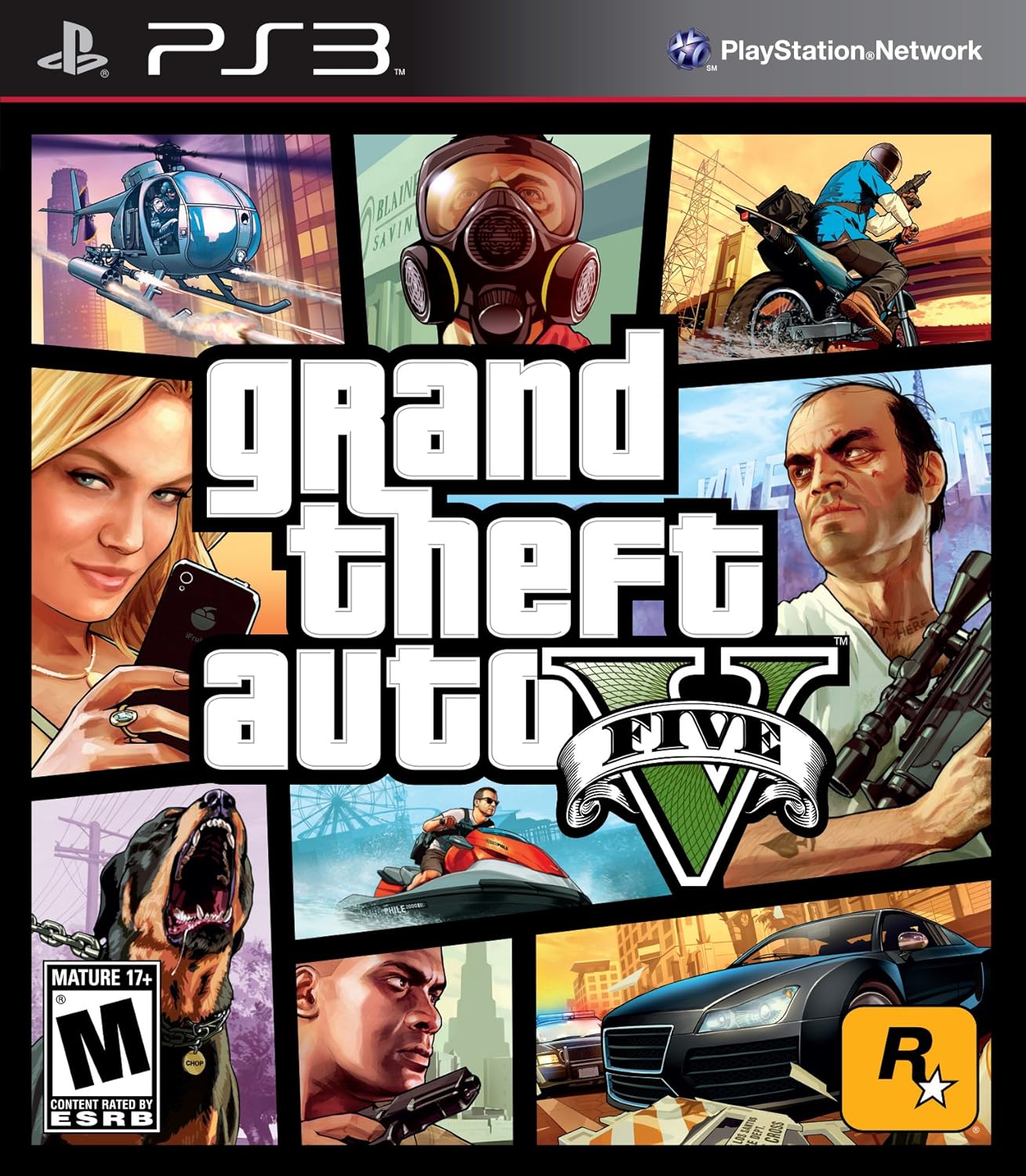
Apart from the art style's treatment of lighting, and the smallness of details such as the face of the figure in the helicopter or the hands of the motorcyclist, I happen to know that GTA5 is set in a Los Angeles-like city, where I would expect a great many people to be — in SJW terms — white-passing POC. The tattooed man on the right, possibly white, could easily be POC. The POC man in the bottom center could be white with different assumptions about how he is lit.
The developer, Rockstar North, is Scottish. They are owned through Rockstar Games (American) by Take-Two Interactive (American). Take-Two is better known through its subsidiaries, Rockstar and 2K (American).
Mario Party 10
The cover has six visible characters, three of which are nonhuman (Bowser, Yoshi, and a green blob I don't recognize), and three of which are white (Peach, Mario, and Luigi). Peach has blonde hair and exceptionally fair skin. Mario and Luigi have fair skin. All three have blue eyes.

Nintendo is Japanese, and Mario and Luigi are canonically Italian, as if I needed to tell anyone this. I am not sure about the supposed racial history of the Mushroom Kingdom and its royal family.
Xenoblade Chronicles
The cover has no visible human figures. A red sword of unusual design is thrust into a grassy field near part of a rough wooden fence and an unidentifiable object in poor condition. Above this is the title, and above that is a vaguely humanoid, heavily armored construct with glowing red lights in the area you'd expect to find eyes.

Monolith Soft is a Japanese developer, and the game appears exclusively on Nintendo platforms.
The Sims 4
The cover shows eight people. Top row, left to right: white, white, white. Middle row: POC, unsure. Bottom row: white, white, unsure.

The last time I played a Sims game, you could make custom characters and even populate an entire neighborhood with them.
Developed by Maxis/The Sims Studio (American), owned by EA (American).
Conclusions
Five out of eight covers do not have any racially identifiable figures. (Two out of eight do not have human figures at all.) Of the remaining three, only Mario Party 10 has no POCs. GTA5 is very difficult to assess, but I believe the cover has at least one POC. The Sims 4 has between one and three POCs, and I presume that in the actual game it is possible to have POC characters.
The Twitter SJW who suggested this inquiry told me, "Look beyond the games you play. Learn something." The intention, or so I suppose, was that I would look at the box art of top sellers on vgchartz and be converted to the SJW position that there must be more POCs and less whites in video games than there are now. Instead, I didn't see anything to contradict my own position that if you like games with POCs (and judging by similar questions about gender, most people probably don't have a strong enough preference to change the games they play) you can play them right now, with no alteration of the hundred-billion-dollar video game industry necessary.